
For restaurants, break-fix IT support is a false economy because the unplanned downtime, lost covers, and reputational damage it creates almost always cost more than a fixed-fee, proactive managed IT service over the course of a year.
Imagine an 11-site casual dining group where two venues lose their POS and network just after the first wave of bookings sits down. Card terminals time out, online orders keep flowing in, and the team falls back to pen-and-paper while the manager phones a break-fix provider who is trying to find an engineer nearby.
In my experience, this is where the old reactive model stops looking economical and starts looking exposed. Once ordering, payments, delivery, guest Wi-Fi, back-office reporting, and multi-site oversight all depend on connected systems, IT support becomes part of service delivery rather than a background utility.
How break-fix restaurant IT really works
On paper, break-fix looks simple. You only pay for IT support when something breaks: an engineer visits, fixes the immediate fault, sends an invoice, and disappears until the next crisis.
For restaurants, the model usually means there is no active monitoring, patching is delayed because nobody wants to risk disruption before service, hardware stays in place too long, and every serious incident starts with a fresh scramble for attention.
Most operators live with small warning signs for months. A terminal drops off the network and comes back. The Wi-Fi becomes unreliable in one part of the venue. A site needs another reboot than it should. Because each incident seems manageable on its own, the wider pattern goes unchallenged.
Where the weakness becomes obvious is in multi-site restaurant IT. A group does not need every site to fail at once to have a serious problem. It only needs enough sites to develop faults often enough that head office, managers, and teams are constantly pulled into avoidable operational noise.
I would argue that break-fix is not just a support model. It is a decision to accept low visibility, inconsistent maintenance, and unpredictable recovery times across an estate that trades at night, over weekends, and during peak windows when delays cost the most.
The hidden cost of reactive IT
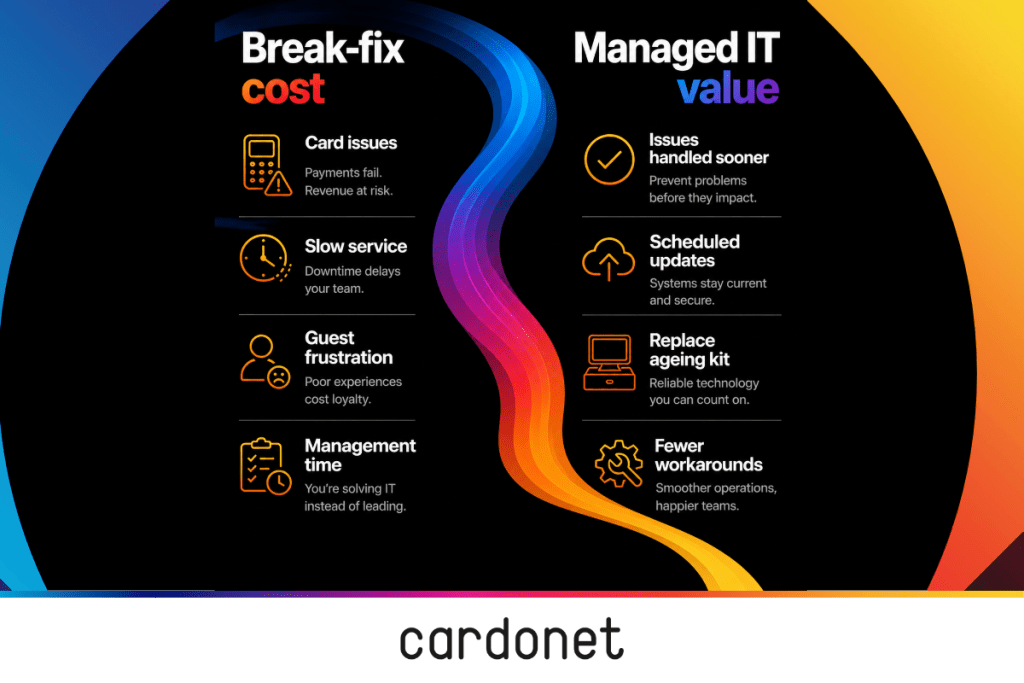
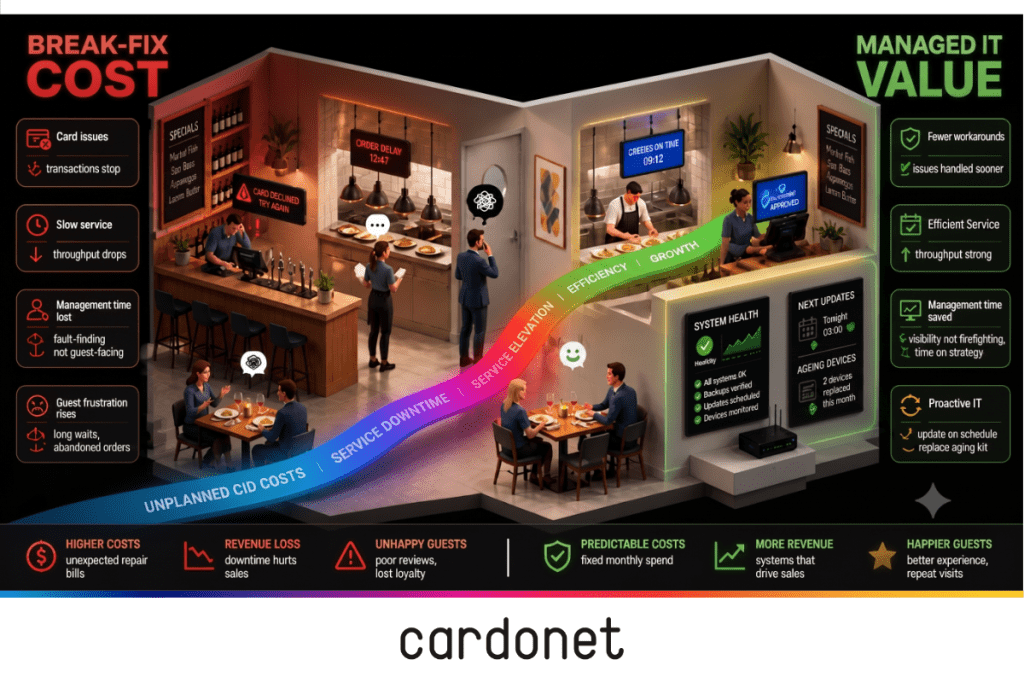
If a restaurant group only compares support invoices, break-fix will often appear cheaper than a managed service. The real cost sits elsewhere: in slower table turns, staff overtime, failed payments, delayed delivery orders, guest frustration, and the reputational drag that follows visible service disruption.
When POS and connectivity fail during service, the operational damage spreads quickly. Staff switch to workarounds, managers stop managing and start firefighting, and every manual step creates another chance for error or delay.
The technical repair bill is usually the smallest part of the incident. In practice, the bigger cost often sits in lost productivity, service disruption, and customer impact — something Cardonet’s 24/7 Network Monitoring Service makes explicit, noting that IT downtime can damage customer experience, reduce revenue, and seriously affect productivity.
This is the point many operators miss. Break-fix can look disciplined because the monthly spend is low right up until the business absorbs the cost in discounts, payroll, lost covers, churn, and management time. The P&L still pays for the failure – it just pays for it in the wrong places.
Most IT advice on this misses the point. Restaurants do not experience downtime as an abstract technical event. They experience it as operational drag in the middle of service, when guest patience is short and every workaround has a margin cost attached.
A reactive model also makes budgeting harder. Instead of planning for maintenance, refresh, and support as known operating costs, the group absorbs sharp, inconvenient spending spikes tied to equipment failure or neglected updates.
What proactive restaurant IT support includes
Proactive restaurant IT support changes the question. Instead of asking who can come out when something breaks, it asks what should be monitored, patched, standardised, and replaced before the fault reaches the floor.
Three elements matter most.
Structured patch management
Patch management matters for stability as well as security. Restaurant POS environments, operating systems, and supporting applications all need a defined update process, agreed maintenance windows, and central visibility across the estate.
This is also where restaurant POS security becomes practical rather than theoretical. Cardonet’s article on restaurant POS securityhighlights the risks created by weak segmentation and flat networks, especially where guest Wi-Fi and payment systems share infrastructure. That same operational discipline is reinforced in Cardonet’s restaurant PCI compliance page, which ties payment protection to ongoing compliance rather than one-off fixes.
24/7 restaurant network monitoring
Monitoring is what stops support from being blind. Cardonet’s restaurant network monitoring page positions always-on monitoring as a core operational control, allowing issues or irregularities to be detected and acted on quickly rather than waiting for staff to raise the alarm.
For restaurants, that matters because trading does not happen on office time. Connectivity, switching, wireless performance, and core devices all need to be watched during the hours that actually matter to revenue.
Planned hardware lifecycle and replacement
Managed support should also include a defined hardware lifecycle. If POS terminals, network devices, and key infrastructure remain in use until they fail under load, the business is treating failure as a maintenance strategy.
A stronger model sets refresh expectations in advance, budgets for them, and prioritises the equipment most likely to cause disruption. Across a multi-site estate, standardised hardware also makes support cleaner because there are fewer one-off devices and configurations to diagnose under pressure.
Implementing managed IT across a restaurant group
Moving from break-fix to proactive support is not just a supplier change. For a restaurant group, it is an operational redesign that creates clearer standards, better visibility, and more predictable cost control across the estate.
A sensible rollout usually starts with a structured audit. The group needs to understand what is deployed at each site, how old it is, where support responsibilities sit, and which systems are already outside a sensible lifecycle.
From there, the next job is standardization. Preferred hardware, network design, patching rules, escalation paths, and service windows need to be consistent enough that support can be repeatable rather than improvised.
The financial discipline comes from replacing surprise spend with planned spend. A managed model is easier to judge properly because the operator can compare a fixed service cost against real downtime, overtime, discounting, engineer call-outs, and replacement spending over the last year.
Service agreements also need to reflect restaurant trading reality. A generic business SLA that works for a nine-to-five office does not match a group whose most important operating hours are evenings and weekends.
What good looks like is less dramatic than many operators expect. Fewer incidents, faster diagnosis, cleaner recovery, and less dependence on individual heroics at site level. Once that happens, head office gets back time, site teams get consistency, and technology stops interrupting service as often.
What good restaurant IT looks like
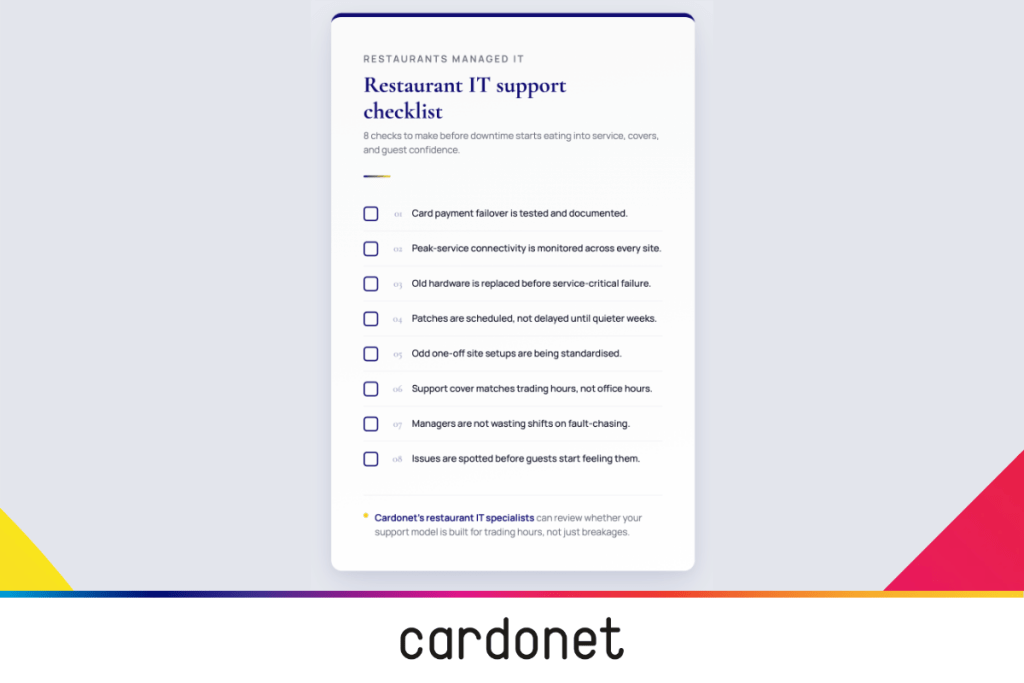
Good restaurant IT is not defined by flashy systems. It is defined by consistency. Core systems stay available, incidents are seen earlier, updates happen in a controlled way, and hardware refresh is expected rather than postponed until failure.
For a multi-site group, that usually means:
- Clear uptime and response expectations for POS, connectivity, and core back-office systems.
- Patch records showing what has been updated, where, and when, with exceptions tracked rather than ignored.
- Monitoring that gives visibility across sites instead of relying on managers to discover faults first.
- A hardware lifecycle policy that replaces guesswork with dates, budget planning, and prioritized refresh.
A practical baseline line for a managed agreement could read like this:
All POS terminals and core network devices across the restaurant estate must remain within supported vendor lifecycles, be actively monitored, and be refreshed on a planned schedule that is budgeted in advance and reviewed annually.
The wider benefit is not just technical reliability. It is operational calm. Managers spend less time chasing faults, teams work with fewer awkward workarounds, and support becomes part of protecting margin rather than a distress purchase made after the damage is already done.
Why this matters
Restaurant groups depend on service flow. That means IT issues do not stay in an IT box for long. They spill into speed of service, review scores, staff pressure, order accuracy, guest confidence, and the ability to scale sites without multiplying complexity.
That is why proactive managed IT belongs in the same category as other core operating disciplines. It is part of how a group protects revenue, standardizes execution, and reduces avoidable volatility across the estate.
Next steps
- Audit three representative sites – a flagship, a typical location, and one that has recurring issues.
- Compare managed support pricing with the last 12 to 18 months of break-fix spend, downtime impact, overtime, and ad hoc replacements.
- Ask your current or prospective IT partner to show, in writing, how they patch, monitor, and refresh your three most service-critical systems over the next three years.
FAQs
Is break-fix IT support ever right for a restaurant?
It may be tolerable for a simple single-site operation with limited technology dependency, but the risk rises quickly once cloud POS, delivery integrations, guest Wi-Fi, or multiple venues are involved.
How does proactive restaurant IT support reduce downtime?
It reduces downtime by combining monitoring, patch management, and planned replacement so faults are spotted earlier and weak points are dealt with before they fail during service.
Is managed IT always more expensive than break-fix?
It often costs more as a visible monthly line item, but the wider annual cost can be lower once downtime, overtime, guest disruption, and reactive replacements are included in the comparison.
What should a multi-site group look for in a managed IT partner?
Look for hospitality experience, 24/7 monitoring, clear patch and lifecycle discipline, and service levels that reflect real trading hours rather than office assumptions.
How does restaurant POS security fit into managed IT?
POS security depends on more than the POS platform itself. It relies on patching, monitoring, and sound network design around the payment environment, including proper separation from guest Wi-Fi where needed.

You must be logged in to post a comment.