
In adaptive reuse hotels, hotel conversion IT is rarely straightforward. Developers, owners and asset managers do not buy an ex-office or student block because it is a perfect hotel building. They buy it because the numbers work – until guests arrive, the building management system (BMS) thinks it’s still an office, and hotel Wi-Fi, door locks and room controls start colliding with legacy cabling and old containment decisions.
Conversion plays only work when your IT, BMS and connectivity plans are based on the building you actually own, not the one on the glossy renders.
Why hotel conversion IT gets messy fast in adaptive reuse hotels
On paper, adaptive reuse can look compelling. It can reduce construction time, reuse existing structure and support a stronger sustainability story, which is why hotel investors and developers keep returning to it. In schemes like these, the spreadsheet often behaves better than the building does.
In practice, however, the building sets the rules. Old risers, shallow ceiling voids, awkward containment and half-documented plant create hard limits that standard hotel technology designs regularly underestimate. By the time weak coverage, unstable room controls or poor systems integration become obvious, the building is already trading.
In my experience, the worst conversion projects are not always the most complex. They are usually the ones treated like routine refurbishments until the first guest complaints prove otherwise.
How inherited building constraints affect hotel IT infrastructure
In a new-build hotel, riser locations, plant rooms and ceiling depths are designed around the final operation. In a conversion, those fundamentals are inherited. In most reuse schemes, that means the building decides what your hotel IT infrastructure can realistically support long before the drawings look finished.
Typical inherited constraints include:
- Riser locations that worked for desks, not bedrooms.
- Ceiling voids sized for office lighting, not fan coil units, access points and hotel cabling.
- Plant and service routes planned around weekday occupancy, not a live hotel running all day and night.
Some of this can be changed, but usually at a price. Moving risers, cutting new routes and reworking containment can burn through contingency quickly. That is often where adaptive reuse starts giving back the saving that made the scheme look attractive in the first place.
That is why early reality-mapping matters. Before the design is treated as fixed, someone needs to test likely cable routes, identify dead zones and challenge whether the shell can support the guest experience being promised.
Hotel BMS integration risks in buildings that used to be something else
A building management system should make a hotel behave consistently. In a reused shell, it often behaves like the previous building type instead.
Many existing BMS setups in offices or student accommodation are tuned around patterns that look nothing like hotel life. Office schedules assume predictable occupancy, stronger night setbacks and different comfort patterns; hotels do not work like that. When those assumptions remain in place, the results are familiar:
- Guest rooms that never quite reach setpoint during busy periods.
- Public areas that swing between too warm and too cold.
- Controls networks and new IT infrastructure competing for space, ownership and fault-finding attention.
Protocol issues make this worse. Older or proprietary controls often need gateways to connect with newer hotel systems, and every gateway becomes another weak point if ownership is unclear. The blunt question owners need answered early is simple: who owns the controls stack, and has that team actually coordinated with hotel IT and mechanical and electrical consultants?
If not, the building is likely to open with three separate designs pretending to be one coherent system. That is why building management system guidance and a plain-English BMS practical guide are useful sense checks before inherited controls are left to fight the new operating model.
Hotel Wi-Fi and connectivity challenges in non-purpose-built hotels
Guests do not care that the shell used to be an office. They still expect fast Wi-Fi, stable casting or internet protocol television (IPTV), responsive room controls and reliable digital key systems from the moment they check in. In a purpose-built hotel, those expectations are designed in. In a conversion, they often have to be forced through a structure never intended for high-density wireless coverage.
That usually shows up in predictable ways:
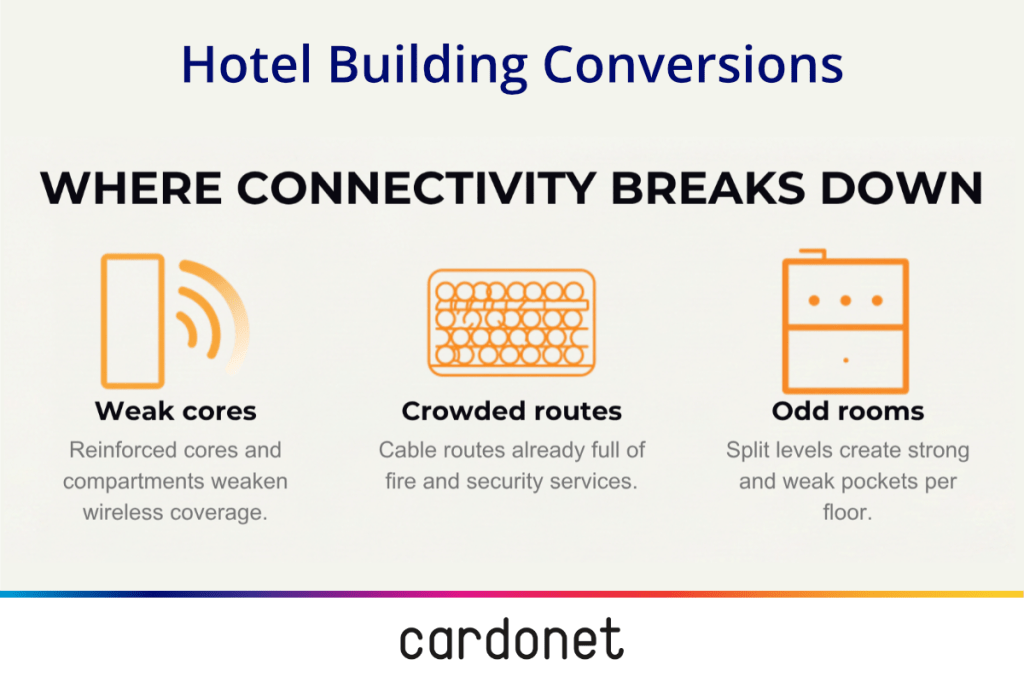
- Reinforced cores and compartmentation that weaken wireless coverage.
- Cable routes already crowded with fire, security and legacy control services.
- Odd room shapes and split levels that create strong and weak pockets across the same floor.
The first ninety days usually expose the truth. A band of rooms may have poor peak-time Wi-Fi because there was no viable route for another cable run. Certain locks may drop offline more often because their controllers sit on overstretched network segments. Public spaces may look fine on drawings but fail under real guest and staff load.
Back-of-house systems suffer as well. Property management systems (PMS), point of sale (POS), finance and admin networks all depend on the same physical infrastructure. If the building cannot support a clean design, operations inherit that risk every day.
Hotel IT commissioning risks in phased conversion openings
Adaptive reuse hotels often open in phases rather than in one clean handover. That is where hotel conversion commissioning risk multiplies.
- BMS commissioning may assume all zones and plant are available in sequence when they are not.
- IT commissioning may assume unrestricted access to risers and rooms that are still in construction.
- Integrated testing is often the first thing compressed when programmes slip.
The result is a building that is technically open but still being tested live. Your team end up debugging door locks, Wi-Fi and room controls with paying guests on site. That is not just frustrating. It is reputational risk, lost staff time and avoidable post-opening cost rolled into one.
Owners and asset managers should insist on three things:
- A commissioning plan built around the real phasing pattern, not the ideal programme.
- Integrated testing for guest-facing systems, BMS and life-safety interfaces under realistic load.
- A proper burn-in period before opening-week occupancy is pushed hard.
If nobody can show how IT and BMS commissioning have been adapted to the way the building will actually open, assume that the first trading period will absorb the cost.
Five conversion plays worth insisting on
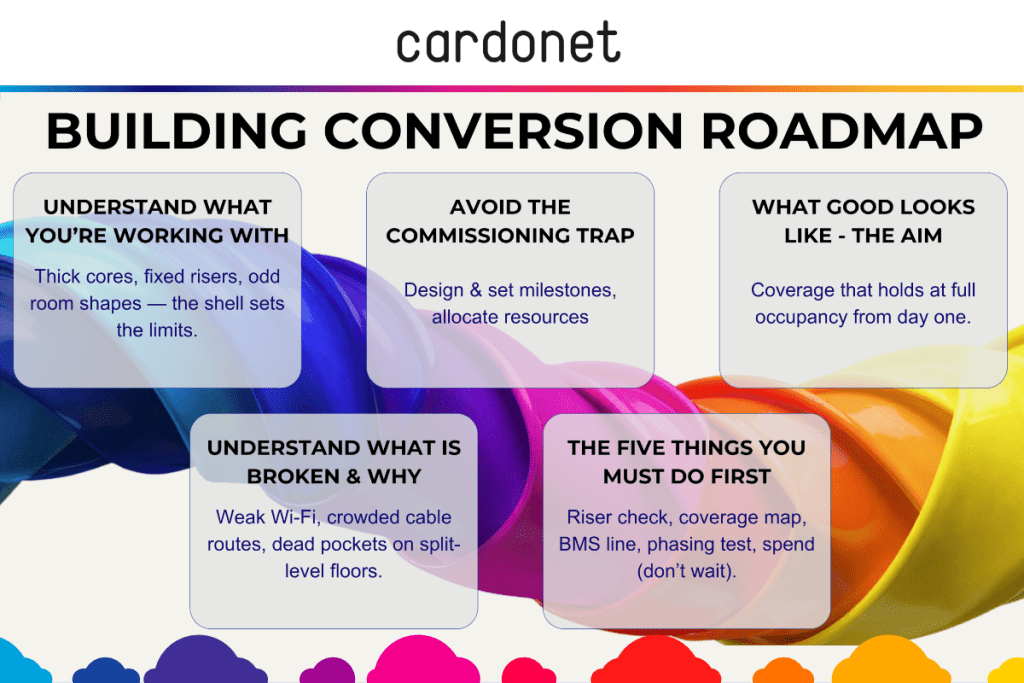
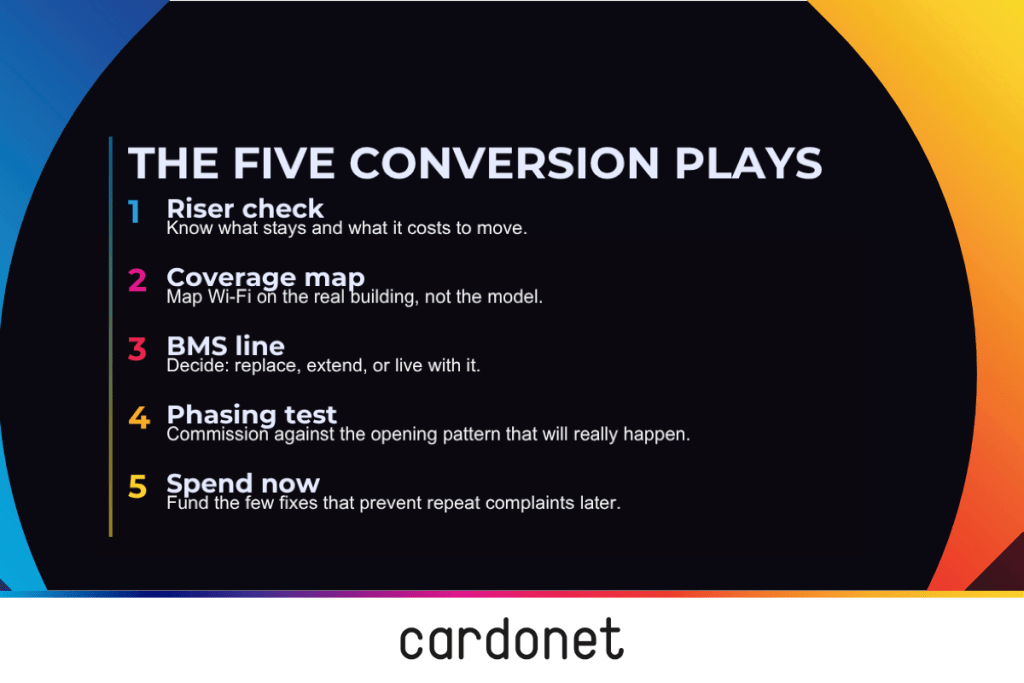
1. The riser reality check. Ask what risers and containment are staying in place and what that means for network design. If nobody can answer clearly, expect late changes and expensive workarounds.
2. The as-is coverage map. Require radio coverage and cable-route planning against the real building, not just the architect’s model. Otherwise, dead zones become a reception problem instead of a design problem.
3. The BMS decision line. Decide whether the existing BMS is being replaced, properly extended or left in place. The muddled middle – partial upgrades plus gateways – is often the most expensive route over time.
4. The real phasing test. Commission against the opening pattern that will actually happen. If testing is built around a theoretical full handover, the first busy weekend becomes the true test environment.
5. The spend-now, save-later list. Identify the few places where extra spend up front prevents repeat complaints later, another riser, a stronger core network, a controls upgrade or simply more honest allowance for additional access points.
None of these plays are about buying extra technology for the sake of it. They are about making sure the shell can support the hotel you plan to run and protecting the guest experience before it becomes an operating problem.
Where Cardonet fits
A specialist hotel IT partner adds value well before equipment is ordered. The real benefit is not just specifying technology. It is exposing where a deal model, drawing package or inherited shell is making promises the building cannot keep. That is where Cardonet’s position is different: as a vendor-neutral partner with deep hotel experience, we are there to challenge assumptions early, coordinate across consultants and contractors, and test the scheme against realistic operating conditions rather than treating guests as the proving ground.
If you are sketching numbers on a conversion, get a building-reality IT and BMS review before you fall in love with the deal. Cardonet can walk the building with you through its Hotel Management IT Consultancy Services, support delivery through Hotel Management IT Solutions, and align technology choices with works already happening through Hotel Refurbishment IT Services, so the operational risk is challenged before it turns into guest complaints, opening delays or avoidable spend.
In conversion projects, the hidden risk is rarely the technology itself. It is the gap between what the building can support and what the operating model assumes. Close that gap early, and the scheme has a far better chance of opening like a hotel rather than a live test environment.
FAQs
1. Why is IT more complicated in a hotel conversion than in a new-build?
Because a conversion inherits risers, plant rooms and ceiling voids that were never designed for hotel operations, so the IT and BMS design has to work around existing constraints instead of setting them from scratch.
2. What are the biggest technology risks in converting an office or student block into a hotel?
The main risks are weak Wi-Fi and guest-facing networks, a BMS still tuned to office logic, and commissioning that never properly reflects phased openings. Those issues usually show up as comfort complaints, unstable systems and staff spending time firefighting avoidable problems.
3. How should owners approach the BMS in a reuse project?
Owners need a clear decision on whether the existing BMS will be replaced, extended properly or left alone – and what that means operationally. A half-upgraded controls environment with extra gateways often increases cost and failure points rather than reducing them.
4. What does getting connectivity right actually involve in a non-purpose-built hotel?
It means mapping wireless coverage and cabling routes on the building as it really is, not just on design drawings, and accepting that some areas may need extra infrastructure to meet guest expectations.
5. When is the right time to bring in a specialist hotel IT partner on a conversion?
The best point is before designs are frozen and before the project team commits fully to the operating assumptions in the deal model. That is when an experienced hotel IT partner can challenge the scheme while change is still possible.

You must be logged in to post a comment.