
A large professional body and a volunteer-run club do not need the same member portal. They do, however, need to solve the same problem. Members must be able to join, renew, access what they are paying for and feel connected to the organization. The budget, tools and support model may be completely different, but the retention challenge is not.
That difference matters, but it should not obscure the core point. Whether your organization is large or small, the member portal shapes the quality of the membership experience. If the digital journey is awkward, membership feels more expensive and harder to justify. If it is clear, secure, and useful, staying feels easier.
Two realities, one problem
Professional IT advice to membership bodies often assumes all organizations can invest like the large professional ones can, with a digital team, integrated systems and a meaningful technology budget. Many, probably most, can’t.
Some membership bodies do have the scale to commission bespoke portals, connect CRM and learning platforms, and use data to spot churn risk early. Others, like youth clubs, local associations, grassroots sports clubs, or PTAs, are run by volunteers who are trying to manage fees, events and communications with the least possible admin burden. They still need to deliver a good member experience. They just need a version of “good” that is realistic.
Different realities, same question: does your portal make the essential member journeys easy to complete, or does it create friction and get in the way?
Four journeys that decide whether people stay
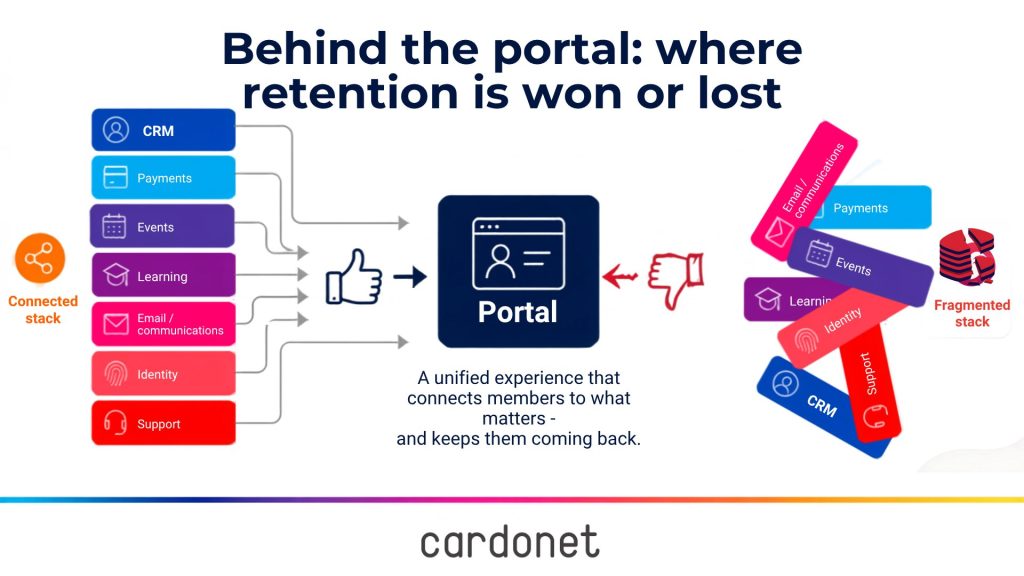
Whatever tools you use, members still need to be able to join, log in, access what they are paying for, and feel connected.
Joining is the first hard test. A prospective member has already decided to commit. The digital journey should help them execute that decision with confidence, not second thoughts. If the form is clunky, the payment step is unclear or the confirmation never lands, the organization starts the relationship by creating extra work for the potential member.
The first login is where a lot of portals quietly fail. A strong portal answers “what now?” in one glance. It shows a welcome, a short orientation, and one or two meaningful actions: complete a profile, claim a core benefit, join a relevant group, or book a flagship event.
Accessing benefits turns the idea of value into something real. Members need to find resources, discounts, events, learning or support without hunting through a maze of pages. If members cannot quickly reach what they joined for, the portal is eroding retention, not supporting it.
Community is the fourth journey. Not every membership body needs a busy online forum, but every membership body does need some visible sense that people belong to something. For a professional body that might mean groups, events and specialist discussions. For a PTA or sports club, it may simply mean easy access to fixtures, volunteering rotas, parent updates or upcoming meetings. The form changes. The need does not.
Across these four journeys, the diagnostic question is blunt. If you walked through each one yourself this week, would you be confident recommending your portal to your own members?
What “good” looks like for bigger membership bodies
For larger and better-funded organizations, “good” usually means integration, relevance and scale.
A single login should open the door to events, learning, member data and community spaces. The member should not need to understand which platform does what. They should just be able to get where they need to go. That level of portal makes richer self-service possible. Members can manage their own profile, CPD activity, membership status and communication preferences without asking staff to intervene.
Behavioral data can also turn the portal into a strategic asset rather than a back-office tool. When you can see which journeys correlate with renewal or upgrade, you can design experiences around those patterns instead of guessing.
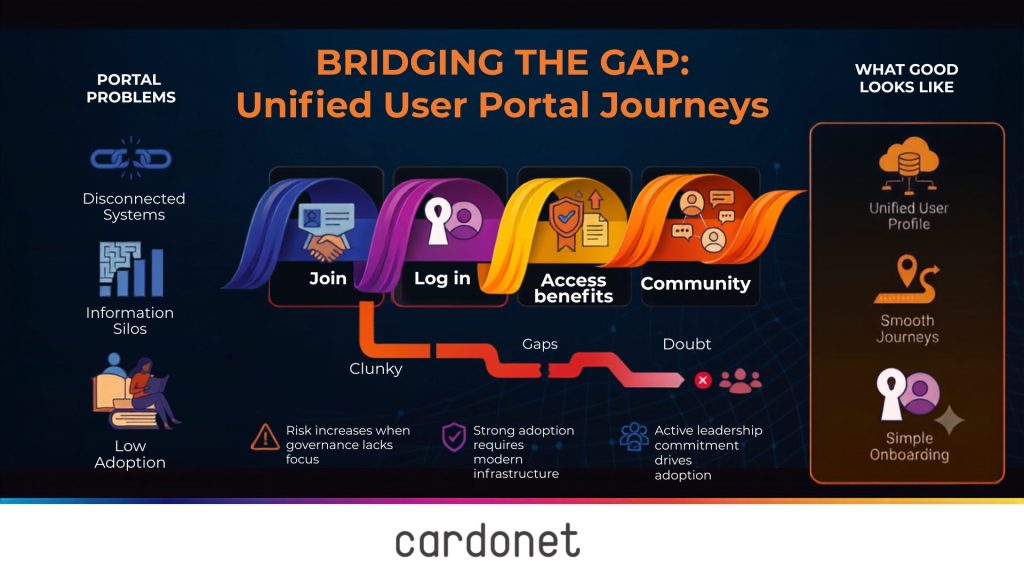
That is where the underlying IT architecture matters. A portal is rarely just a website; it usually depends on CRM data, payment systems, event tools, learning platforms, email, identity management and support processes. If those systems are fragmented, every member journey becomes harder to manage and harder to trust.
A connected stack makes it easier to deliver one clear experience, keep member records accurate, reduce manual support requests, protect sensitive data and recover quickly when something goes wrong. The member only sees the portal, but the quality of that portal reflects the quality of the systems behind it.
For a law society, medical college or engineering institution, that is not optional. Members at this level are unlikely to tolerate repeated logins, confusing self-service, unreliable access or inconsistent data. At scale, poor portal experience turns into reputational risk, support cost, cyber risk and churn.
What “good” looks like for smaller clubs and volunteer-run bodies
For smaller organizations, a different reality applies. It is not about building a mini enterprise system on a PTA budget. It is about making the basic journeys easy enough that volunteers are not drowning in admin and members are not put off by avoidable friction.
That usually means a simpler mix of tools. A low-cost membership or CRM platform, a website people can actually navigate, straightforward payments, and one obvious place to check status, renew, or find out what is on. The lesson is broader than any one supplier. Smaller organizations benefit most from simple systems that reduce handoffs.
That mindset fits youth clubs, sports clubs and PTAs well.
For a grassroots body, “good” can be defined in three straight lines:
- People can join without emailing several different volunteers.
- Members can see whether they are current and renew online.
- Events, updates and key information live in one clear place.
That is not second-rate design. It is appropriate design for the money, skills and time available. It also respects members’ expectations. Parents, supporters and local members may forgive the absence of polish. They are less forgiving when paying, renewing or finding information becomes unnecessarily awkward.
Next steps for both realities
The simplest way to move forward is to stop looking at the portal as an internal system and start using it exactly as your members do.
Join as a new member and see how it actually feels. Log in as an existing member and note how long it takes to reach a benefit, book an event or renew. Try to find a specific resource or community space without insider knowledge. If you feel even a flicker of irritation, your members feel it too.
Then decide, honestly, which reality you are in and what a practical, sustainable standard looks like for your organization.
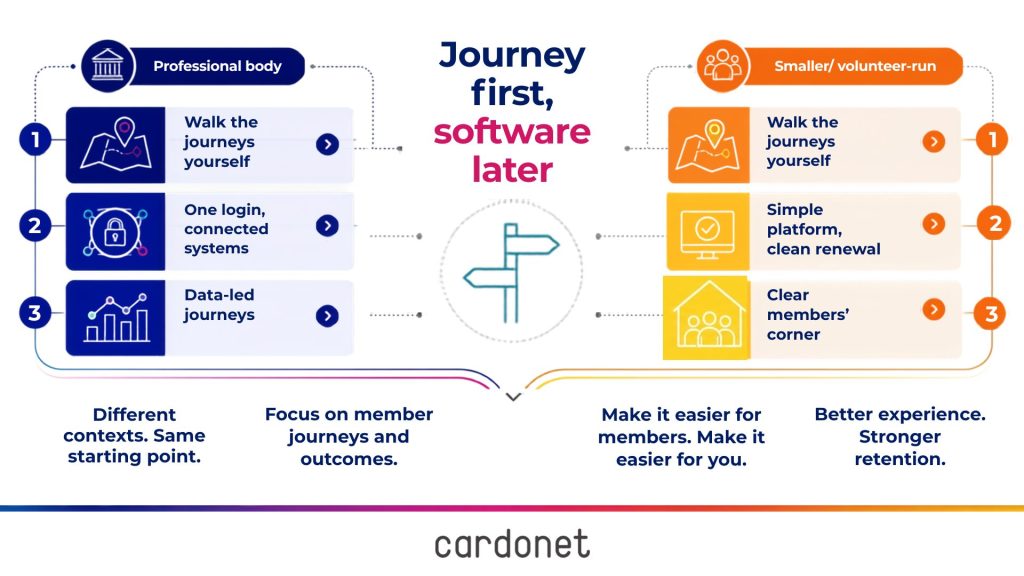
If you are a professional body, that might mean committing to one login, connected systems and data-led journeys that deliberately steer members towards the two or three actions most linked to renewal. If you are a smaller club or volunteer-run association, it might mean picking one simple platform, fixing the join and renewal paths, and putting a clear, up-to-date “members’ corner” on your site.
Where Cardonet would usually start is with the journey, not the software. Map the current join, login, renewal and benefit-access paths; identify where members drop out or staff intervene; then look at the systems causing the friction. In many cases, the right answer is not a new portal first. It is clearer ownership, better integration, cleaner data, stronger access controls and a support model that keeps the experience reliable over time.
You can stress-test that decision with three practical questions:
- Do you know which portal journeys cause the most complaints or confusion?
- Have you fixed those journeys before investing in new tools or features?
- Can your team explain, in plain language, why the portal looks and behaves the way it does for your members?
The problem is shared. Members need digital experiences that make staying feel easy, worthwhile and normal. The right solution depends on scale, budget and internal capacity. But in every case, the portal is part of the retention strategy, not a side project.
If you lead a membership body, start with the two journeys your members complain about most. Fix those before adding more features. If the friction sits in the systems behind the portal, that is where the real work begins.
FAQs
How good does a member portal really need to be for a small club or PTA?
It needs to be good enough to remove avoidable friction from the basics. If people can join, renew, find key information and book what they need without chasing volunteers, the portal is doing its job.
Can a membership body improve retention without investing in a bespoke portal?
Yes. Retention improves when essential journeys work properly, not when an organization buys the most advanced platform available. For many smaller bodies, a simpler setup with clean join and renewal paths is more practical and more effective than a half-used complex system.
What are the first member portal journeys a membership body should fix?
Start with joining and renewal, because those are the moments where members feel friction most directly. After that, focus on benefit access and whichever form of community matters most in your organization, whether that is events, groups, updates or a members’ area.
How can a larger professional body tell if its member portal is hurting retention?
A good test is to walk through the main journeys as if you were a member and see where the experience creates work. If the portal relies on repeated logins, confusing self-service or inconsistent data, that friction will show up in complaints, weaker engagement and eventually renewal risk.
What does “good enough” member self-service look like in practice?
That depends on the reality of the organization. For a professional body, it may mean one login, connected systems and clearer data-led journeys; for a volunteer-run association, it may mean one simple platform, a tidy members’ corner and a renewal process that does not create extra admin. In both cases, good enough means the portal makes staying feel straightforward rather than effortful.

You must be logged in to post a comment.