
I am old enough to remember the days when (some) CEOs treated their PC and email as administrative clutter rather than as part of the job. They could still run a business, command a room and make the big calls, but there was always something slightly unreal about it because the machinery of the company had already moved on without them. Information was beginning to travel differently, decisions were being shaped differently, and the people closest to customers and operations were starting to work at a speed and level of visibility those leaders had never really experienced for themselves.
This has been on my mind a lot recently because I see the same pattern emerging with AI.
Not in the loud, obvious way people talk about online, and not in the simplistic sense that every CEO must become obsessed with models, prompts or whichever tool is fashionable this week. It’s quieter than that; are the people at the top willing to use AI as part of their own working life, or are they content to treat it as something for the innovation team, the CIO, or a younger layer of management to figure out for them.
You can see the gap clearly in the way some leaders now talk about their own workforce. A bank chief executive recently described plans to use AI to replace “lower-value human capital”, and then had to apologise after staff and the wider public reacted to the phrase. He had missed the underlying truth – that over any sensible planning horizon, it will still be people who build trust, navigate judgment calls, deal with edge cases, implement change and decide how AI gets used responsibly. AI will become an essential part of delivering results; it will not, on its own, decide which organizations succeed.
No doubt, automation will change roles, and some jobs will go but framing people primarily as low-value inputs to be swapped out for machines as soon as possible is simply wrong.
That is why I think the organizations that pull ahead over the next few years will not necessarily be the ones shouting loudest about AI, or the ones with the most aggressive headcount charts. More often, they will be the ones whose senior leadership teams have quietly decided (or accepted, however unwillingly) that this is part of the operating environment now and will have adjusted their own behavior accordingly. They will ask better questions, move faster on the right opportunities, and spot weak thinking earlier because they are not trying to lead through second-hand explanations.
CEO AI adoption is really about leadership behavior
A lot of AI discussion still gets trapped in the wrong place. It drifts into model comparisons, technical jargon, vendor claims and speculative debates about what may or may not be possible next year. Most of that is a distraction for the average CEO. The question that matters is simpler and far more uncomfortable: is the leadership team itself changing how it works, or is it expecting everyone else to change first?
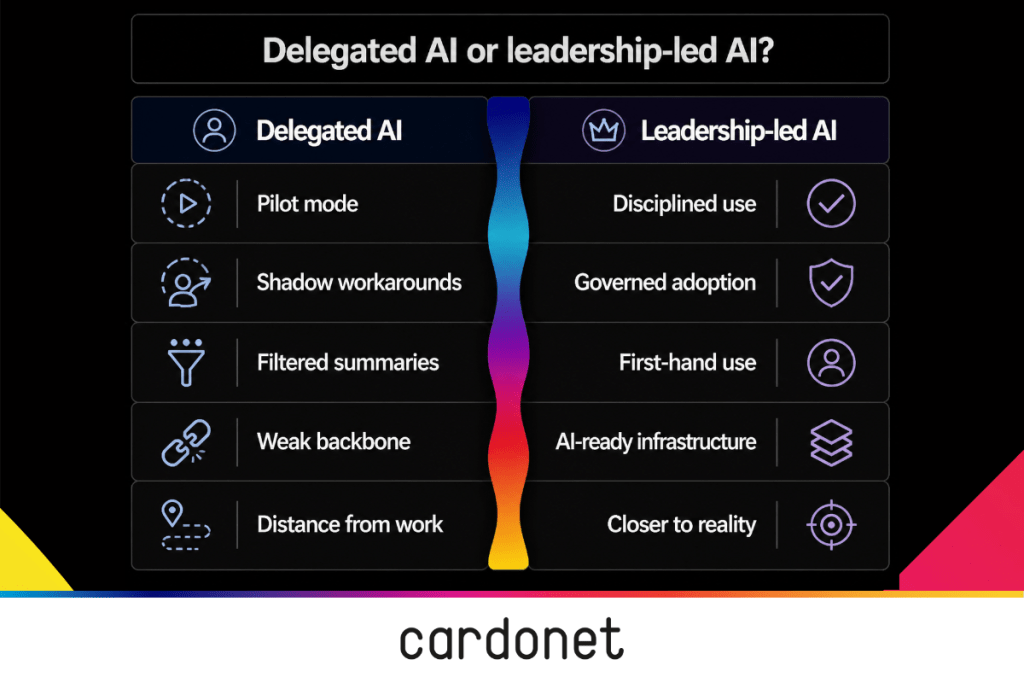
Research keeps pointing to the same underlying problem. In many organizations the barrier is not access to AI, and it is not even lack of interest. The bigger issue is the gap between having tools available and embedding them into everyday decision-making, workflows and culture. That gap widens very quickly when senior leaders champion AI rhetorically but keep it out of their own routines. People aren’t dumb, and they notice. They notice which tools leaders actually use before meetings, how they prepare, what they ask for, what they reward, and what they ignore.
The reason this matters is not symbolic. Leadership behavior sets the temperature of adoption. If the executive team treats AI as a side conversation, a future capability or a delegated workstream, most of the organization will do the same. There may be experimentation around the edges, and there may be pockets of good practice, but the overall message becomes clear: use it if you want, but do not build your real working life around it yet.
That is exactly how businesses fall into the awkward middle ground where they have bought the licenses, run the pilots and held the workshops, yet still feel curiously unchanged. Or worse, when teams have quietly built their own unsanctioned workarounds, and the real AI adoption is happening in the shadows instead of where it can be seen and guided.
On the other hand, when a CEO has begun to use AI in ordinary executive work, something shifts. The conversation stops being abstract. It becomes much easier to talk honestly about where the technology is genuinely useful, where it introduces risk, where it saves time, and where it exposes weaknesses in process or infrastructure that had previously been tolerated. That kind of leadership does not create theatre. It creates traction.
The consequences of being left behind are organizational, not cosmetic
One of the mistakes businesses make is to assume that a senior team can remain personally detached from AI while the organization modernizes underneath them. In theory that sounds manageable. In practice it creates gradual drag and management misses the pattern until competitors are already moving with more confidence.
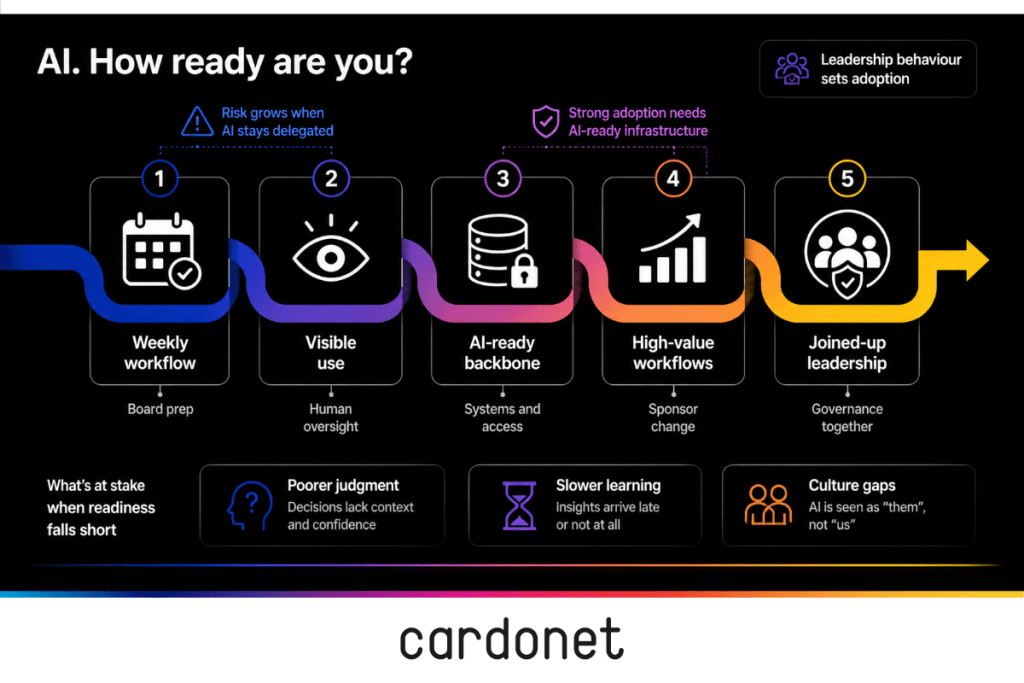
There a three clearly identifiable consequences.
- Poorer judgment
If a CEO never uses AI to interrogate a market trend, challenge a planning assumption, or test a piece of reasoning before a high-stakes meeting, they are missing an important new layer of perspective. AI does not replace experience but not using it means that a leader who refuses to engage with it is narrowing their own field of view at the exact moment when the range and speed of available information is expanding. They remain dependent on filtered interpretations from others, and over time that weakens the quality of strategic questioning. - Slower organizational learning
Teams often take their cue from what leadership demonstrates, not what it announces. When executives avoid direct use of AI, middle management tends to become cautious as well. The safest uses survive: polishing wording, summarizing notes, automating low-risk admin. The more meaningful uses, the ones that reshape decisions or redesign workflows, are held back because no one wants to overstep. What looks like prudence from the top becomes hesitation everywhere else. - Culture gaps
Businesses that adapt well to new technology tend to have a visible sense that learning is part of leadership, not something delegated downwards. Businesses that struggle often carry the opposite signal: senior people are exempt from changing how they work, while everyone else is expected to catch up. That arrangement rarely ends well. It breeds cynicism, encourages box-ticking and makes transformation feel performative rather than real.
Why this moment feels bigger than another technology cycle
There have been plenty of overhyped technologies in the past, and most experienced executives know better than to lurch towards every new shiny thing. Skepticism is healthy. AI does not deserve automatic trust, and nobody should be asking leaders to suspend their judgment. But there is a difference between being skeptical and being absent.
At the time of writing, AI is moving from a phase of broad experimentation into something more consequential. Major firms are pointing to a shift from scattered pilots towards attempts at real operational scale, while business leaders continue to report that the main barriers are now governance, readiness, culture and organizational capacity rather than simple access to tools.
In other words, the question is no longer whether AI exists or whether it can produce interesting outputs. The question is which organizations can absorb it properly.
That is part of the reason the broader market matters, even if this article is not really about specific tools or model releases. Companies such as Anthropic, alongside other major AI players and the larger platforms building AI into everyday business software, are starting to look less like experimental challengers and more like the foundations of the next operating environment. At the time of writing, the momentum around funding, partnerships and potential public market activity suggests that these businesses are becoming structural, not peripheral. History usually rewards leaders who recognize shifts early enough to adapt their own behavior before the rest of the market makes the choice for them.
That is why I come back to the analogy with the old PC-and-email holdouts. The issue was never that they failed to predict every technical development. It was that they misread the significance of a behavioral shift. They thought they could stay strategic while remaining personally detached from the tools changing the pace and shape of work around them.
For a while, they got away with it. Then the gap became impossible to ignore.
AI-ready leadership still depends on boring things done well
There is another truth here that tends to get overlooked in the louder AI conversation. Even the best leadership intent will come to very little if the business underneath it is not set up to support the change. One reason some firms make faster progress is not that they have more visionary slogans. It is that the practical foundations are in better order.
If AI is going to become part of everyday work, then managed IT matters. Cloud architecture matters. Cyber security matters. Communications tools matter. That may not be the glamorous side of the conversation, but it is usually the part that determines whether adoption is smooth, safe and scalable, or frustrating, risky and patchy.
A leadership team that begins using AI properly tends to discover this very quickly. People start running into identity issues, inconsistent access, fragmented data, weak governance, poor integration between systems, or security concerns that were previously tolerable but become more serious when AI is added into the mix. These are not reasons to avoid adoption but they are reasons to take the underlying environment more seriously.
This is also where experienced partners matter, even if nobody wants a sales pitch in the middle of a leadership article. Staying ahead is rarely about making one dramatic leap. More often it comes from quietly fixing the conditions that let better habits stick:
- cleaner systems
- more reliable support
- stronger security operations
- better cloud decisions
- more resilient communications.
Businesses that get these basics right give their leadership teams the confidence to adopt new ways of working without feeling they are building on sand.
You cannot lead from outside the operating system
What I find most striking in conversations about AI is how often leaders describe it as though it were happening around them rather than through them. They talk about readiness, investment, governance and experimentation, all of which matter, but sometimes with the air of someone discussing weather conditions. Useful to monitor, important to respect, but somehow separate from the daily mechanics of leadership.
This is not sustainable. If AI increasingly shapes how teams gather information, frame choices, prepare communication and test assumptions, then senior leaders need enough direct contact with it to understand the difference between genuine leverage and expensive noise. They do not need to become technical specialists. They do need to stop outsourcing first-hand experience.
That is what makes this a leadership issue rather than a technology issue. A chief executive who uses AI thoughtfully is not trying to appear modern. They are reducing the distance between how they lead and how work happens and improving the odds that strategy, culture and infrastructure can evolve together rather than in fragments. This also means that they are far more likely to ask the kind of grounded questions that keep an organization from drifting into either complacency or hype.
A practical AI adoption framework for CEOs and leadership teams
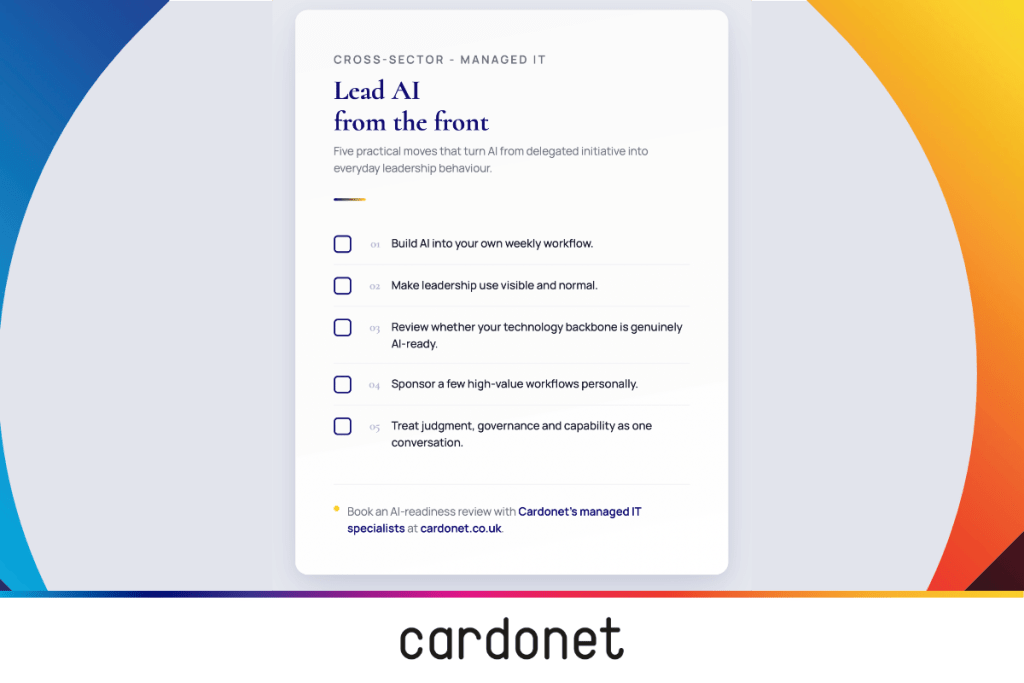
For leaders who do not want to be the modern equivalent of the executive who never learned to use a mouse, the answer is not to perform enthusiasm. It is to adopt a small number of practical behaviors and stick with them long enough for the organization to take the cue.
1. Build AI into your own weekly workflow
Start with work that already matters to you. Use AI to prepare for board meetings, test the strength of a key argument, compare strategic options, or review patterns in customer and operational feedback. The point is not to use AI everywhere. The point is to make sure your understanding comes from direct experience rather than second-hand summaries.
2. Make leadership use visible and normal
When you use AI in a meaningful way, say so. Explain where it helped, where it was weak and where human oversight still did the heavy lifting. That kind of visible, ordinary use does more for organizational confidence than another broad statement about innovation, because it shows that experimentation is part of serious work rather than a side project.
3. Review whether your technology backbone is genuinely AI-ready
Ask what would happen if AI usage doubled across the leadership team and then spread into core departments. Would your devices, access controls, support model, cloud environment, security monitoring and communication platforms cope cleanly, or would they begin to creak? That review is often where the real blockers emerge, and dealing with them early is usually cheaper than trying to retrofit stability later.
4. Sponsor a few high-value workflows personally
Choose a handful of workflows where better decisions or faster execution would make a visible difference, then stay close enough to learn from the change. That could be strategic planning, client reporting, bid preparation, internal communications, service triage or operational review. What matters is not the label. What matters is that leadership attention helps move AI from experimentation into disciplined use.
5. Treat judgment, governance and capability as part of the same conversation
The firms that move well with AI tend not to split the discussion into disconnected buckets. They look at leadership habits, workforce capability, governance, cyber risk, infrastructure and workflow design as parts of the same operating question. That integrated view is harder work, but it is far more effective than asking one team to “own AI” while everyone else carries on as before.
In the end, the comparison with the old PC-and-email era is useful for one reason above all others. It reminds us that the leaders who fell behind were not necessarily foolish, lazy or anti-progress. Many were highly capable people who simply misjudged how personally they needed to engage with a new way of working. That is the risk now. Not that CEOs will fail to talk about AI, but that they will talk about it from a distance and mistake sponsorship for adoption.
FAQs
- Why does CEO AI adoption matter if the business already has an AI strategy?
An AI strategy on paper is not the same thing as leadership adoption in practice. If the CEO and senior team are not using AI in their own weekly work, most organizations read that as a signal that AI is interesting, but not yet essential, which slows real behavioral change.
- Does every CEO need to become an AI expert to lead well?
No. The point is not technical mastery or constant tool experimentation. It is having enough direct, first-hand experience with AI to ask better questions, judge where it helps, spot where it introduces risk, and avoid leading from a distance.
- Will AI reduce headcount?
In some cases, yes; some roles will change sharply and some tasks will disappear. But the bigger issue for most businesses is not simple replacement – it is whether their people can use AI well enough, safely enough and consistently enough to improve decisions, service and execution.
- What is the biggest mistake leadership teams make with AI adoption?
The most common mistake is treating AI as a delegated initiative rather than a change in how leadership itself works. Once that happens, the organization tends to stay stuck in pilot mode, with scattered experiments but very little operational change.
- What should a CEO do first if they want to lead AI adoption properly?
Start by using AI in a few recurring leadership tasks that already matter, such as board preparation, strategic review, communication drafting or analyzing patterns in operational feedback. That gives you first-hand understanding quickly, and it usually makes the next conversation about infrastructure, governance and team capability far more grounded.
You must be logged in to post a comment.