
Until fairly recently, if you wanted serious operational capability, you hired it. You brought in people to run reports, wire systems together, automate the boring bits, and deal with support and admin.
AI is not replacing good people but it is making certain kinds of work cheaper, faster and easier to access, especially for smaller firms that used to hit a wall the moment they needed specialist help. The cost of capability is falling in real time. Research from the JPMorganChase Institute shows newer small businesses are adopting AI faster and using it across more parts of the business than older firms did at the same stage.
Most businesses are still framing this the wrong way. Rather than asking which AI tool they should subscribe to, they should be asking what work they want to stop paying humans to repeat, and where that work should run. Once framed that way, the conversation moves away from hype and back towards infrastructure, process and cost.
This is where Apple Silicon starts to matter. Apple has put a lot of emphasis on on-device processing, with heavier requests passed to its own private cloud layer when needed, rather than assuming everything should go straight to a third-party data centre. Apple explains that design in its paper on Private Cloud Compute, and, even if you discount the marketing, the direction is important. It points to a model where more useful AI work runs closer to the user, on hardware you already own, with cloud used more selectively.
I am no shill for Apple, and I have criticised them in the past and will criticise them again. But on this, here and now, they are ahead. If you want practical local AI and edge compute in a business context, Apple Silicon is the best option for a lot of firms right now. Not forever. Things will undoubtedly change as competitors catch up. But if the question is what works now, this is where I would start.
Apple Silicon AI for small business already makes sense for local inference, private knowledge work, workflow support and small-team automation, as long as you match the machine to the workload and put proper guardrails in place.
What businesses can do now
There is no need to overcomplicate this. A small business can already use AI to remove a surprising amount of drag from day-to-day operations. Drafting, summarising, first-pass analysis, internal search, scripting help, document handling and workflow automation are all already possible. That is one reason small firms are pushing ahead so quickly: they do not need a huge programme team to get started, they just need a use case worth solving.
There is a lot of noise around “one-person billion-pound companies”, but the useful part of that idea is simpler: AI is lowering the cost of expertise, execution and coordination. A capable founder or a small management team can now get support from software in places where they used to need to hire in, outsource, or just live with the problem.
In practice, I would focus on a short list:
- Drafting and summarising internal material, from notes and reports to policy drafts and updates.
- Automating repetitive operational steps across onboarding, reporting and ticket handling.
- Supporting technical staff with code, scripting and documentation.
- Running private knowledge queries over internal documents.
- Keeping selected tasks local where privacy, speed or control matter more than raw scale.
This is why the hardware question matters sooner than people think. If you start using AI seriously, you quickly move past novelty and into architecture.
Why Apple is ahead
Apple’s advantage here is not just speed. It is the combination of hardware, memory design, power efficiency and a deliberate split between on-device processing and Apple‑run server models, rather than a cloud‑only approach. Apple’s own research on on-device and server foundation models makes that pretty clear. The company is building around the idea that some tasks belong on the device, while others can be offloaded to server infrastructure built on Apple silicon.
That matters for businesses because many of the tasks they actually care about are inference tasks, not training tasks. They want summarisation, retrieval, transcription, coding assistance, automation support and private internal search. They do not need to train the next frontier model. Reuters also reported that Apple has been developing AI chips for data-centre inference rather than training, which fits that same direction of travel rather neatly in my view.
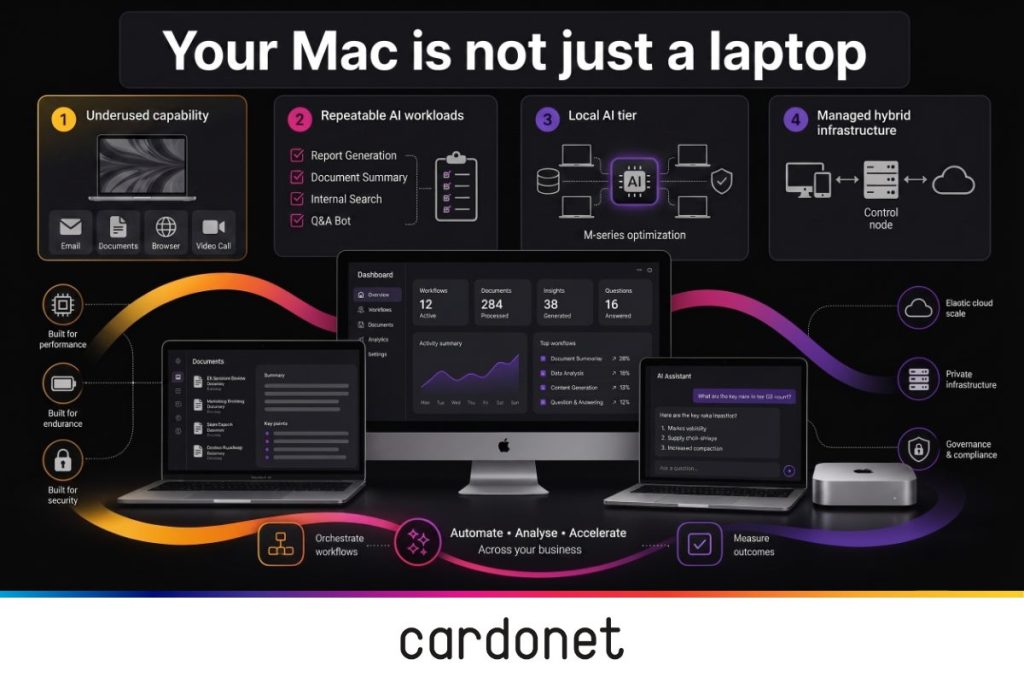
This is where I think a lot of IT buyers are still locked into old mental models. They see a MacBook as an endpoint. Email. Browser. Meetings. Maybe some creative work. They do not yet see it as part of a compute layer. That is beginning to change.
A chips and M chips
Not all Apple hardware belongs in the same conversation.
The A-series chips are good for efficient, mobile-first computing and lighter AI-assisted tasks. The M-series chips are where things get more interesting for business use, because they are better suited to sustained workloads, deeper multitasking, local model work, coding and heavier knowledge tasks.
That does not mean every user needs an M-series machine with a huge memory configuration. It means you should stop buying hardware as if every role is the same. If somebody lives in email, office apps, web tools and embedded AI features, lighter hardware may be enough. If they are doing analysis, development, technical operations, creative production or building repeatable AI workflows, buy for that workload instead.
The simple version looks like this:
| Use case | Better fit |
| General office work with basic AI help | A-series or lighter Apple Silicon device |
| Heavy multitasking, coding, creative work | M-series Mac |
| Private inference, testing and advanced local workflows | Higher-end M-series Mac with more memory |
That is a better way to think about procurement as well: buy for the work, not the logo.
MacBooks as AI nodes
This is the part that gets interesting.
A MacBook with a good M-series chip can be more than a user device. I am not saying it replaces every server, and I am definitely not saying it makes a rack of GPUs irrelevant. What I am saying is that many businesses do not need a rack of GPUs in the first place. They need local inference, private search over internal documents, fast turnarounds on sensitive knowledge work, and a setup that is supportable without setting fire to the budget.
That is why the idea of using Macs as AI nodes is not as strange as it sounds. If you think in terms of a local AI tier, rather than a black-and-white split between “endpoint” and “server”, the model starts to make practical sense.
A smaller pool of properly configured M-series machines can support testing, local model execution, departmental workflows and other approved tasks, while heavier or broader workloads still go to cloud where appropriate.
That is also where managed IT has to grow up. The support model needs to catch up with the architecture where some machines will just be standard user devices while others will be doing real AI work with different controls, monitoring, patching discipline and usage rules.
At Cardonet, this is exactly the kind of crossover we help clients think through – not just managed IT services, but also how device strategy, support policy and security need to change when AI starts becoming part of daily operations. We see the same thing with Apple Mac support, where the conversation is moving beyond user support and into workload planning, device lifecycle and performance fit.
What to do next
Keep the first move simple.
- Start by looking for repetitive work with clear inputs and outputs. That is usually where the quickest gains are.
- Decide which of those tasks can live happily in the cloud and which should stay local because of privacy, latency or cost.
- Map the people who genuinely need AI-capable machines and stop pretending every user should be bought to the same spec.
After that, governance becomes the real issue. If nobody owns the policy, the tools, the data boundaries and the fallbacks, then what you have is not an AI rollout. It is sprawl.
This matters more than people realise. Chase’s 2026 business outlook found that many small firms see AI as important for competitiveness and efficiency, but they also worry about privacy and losing the human touch. Those concerns are healthy. They force the right conversation, which is not “how do we use more AI?” but “where will AI genuinely help, and how do we stay in control while using it?”
You cannot solve that with enthusiasm. You solve it with design.
The longer-term direction is fairly clear. More useful AI work will move closer to the edge. Some of it will still run in cloud but some of it will sit on machines your team already uses. This will allow some businesses to build small, tightly managed local AI tiers and get a lot more value out of them than they ever would from a generic cloud-only approach.
They will still need support, governance and proper security wrapped around it. This is where cyber security services and managed IT come together, because once AI touches internal data, workflows and decision-making, you are no longer talking about a nice tool. You are talking about infrastructure.
For your own infrastructure audit, contact Cardonet and review where your current device estate, workflow design and support model are holding you back.
FAQs: Apple Silicon AI for small business
Is Apple Silicon really the best option for local AI right now?
For many small business use cases, yes. Today it offers one of the strongest combinations of local performance, battery efficiency and practical on-device AI support, especially for inference and knowledge work, although the market will not stand still.
Can a small business run AI locally without buying servers?
Yes, for many tasks. Summarisation, transcription, private document search, coding assistance and selected local models can run on the right M-series Macs without needing dedicated AI server infrastructure.
What is the difference between Apple A-series and M-series chips for AI?
A-series chips are better suited to lighter, mobile-first workloads and general productivity. M-series chips are the better fit for sustained compute, heavier multitasking and more ambitious local AI work.
Should all AI work stay local?
No. A hybrid model makes more sense for most businesses. Keep some tasks local for privacy, speed and control, and use cloud where scale or broader model capability really matters.
What is the first practical step for a business exploring this?
Start with a workflow audit, not a hardware refresh. Find repetitive work first, decide where AI can help, then choose the right machines, policies and support around those tasks.
You must be logged in to post a comment.