
Hotel team-facing technology – housekeeping management, maintenance ticketing, and staff communication platforms – directly determines whether your guest experience delivers on the promise of your brand, from day one of trading.
Your hotel can have a flawless PMS and a spotless lobby – but if the housekeeper doesn’t know the room is ready to turn and the maintenance team is logging faults in a WhatsApp group, the guest experience starts to break down before the guest has unpacked. We’ve seen this pattern repeatedly in pre-opening projects: the front-of-house technology gets obsessive attention, the back-of-house tools get picked in the final fortnight, and the first month of trading becomes an exercise in firefighting rather than delivering the experience the brand promises.
The cost isn’t just operational. A missed room clean, an unresolved maintenance fault, a message lost between departments – each of these translates directly into a negative review, a compensation claim, or a returning guest who doesn’t return. Getting your hotel team technology stack right before opening day is one of the most controllable risk decisions you’ll make.
Your Team Tools Are Your Guest Experience
Most hotel pre-opening checklists treat the PMS as the central technology decision – and it is important – but the PMS only manages what your team has already done. If housekeeping hasn’t marked a room clean, the PMS can’t assign it. If a maintenance fault hasn’t been logged, the PMS won’t flag the room as unfit. The guest experience is built on the coordination between your departments, and that coordination runs through your team-facing tools.
In my experience, the hotels that struggle most in their first three months of trading are the ones where the back-of-house technology was treated as secondary. The hospitality managed IT services conversation tends to focus on guest-facing systems – Wi-Fi, booking engines, payment terminals – but the tools your housekeeping supervisor, maintenance engineer, and duty manager use every day are just as critical to the outcome the guest receives.
There are three categories of team-facing technology that every hotel needs to have in place and integrated before opening day: housekeeping management, maintenance ticketing, and staff communication platforms. Each one has a distinct function, a distinct failure mode, and a direct line to your review score.
The Five Capabilities Your Hotel Team Tech Needs
Before selecting specific platforms, it’s worth being clear about what your team tech stack actually needs to do. These aren’t features – they’re operational requirements that should be non-negotiable when evaluating any system:
- Real-time room status visibility – every relevant team member can see the current state of every room without picking up a phone or sending a message
- Fault logging with priority and ownership – maintenance issues are captured at the point of discovery, assigned to a named individual, and tracked to resolution
- Cross-department handover management – housekeeping completions trigger front desk notifications automatically, without a manual step in between
- Audit trail for guest complaints – when a guest raises an issue, you can trace exactly what was logged, when, and what action was taken
- Integration with your PMS – room status, maintenance blocks, and team assignments flow into and out of your property management system without manual re-entry
The last point is the one most commonly underestimated at the selection stage. A housekeeping app that doesn’t connect to your PMS isn’t a housekeeping solution – it’s a second system your team has to update separately, and within a week of opening, they’ll stop updating it.
How Hotel Team Tech Fails Before Opening Day
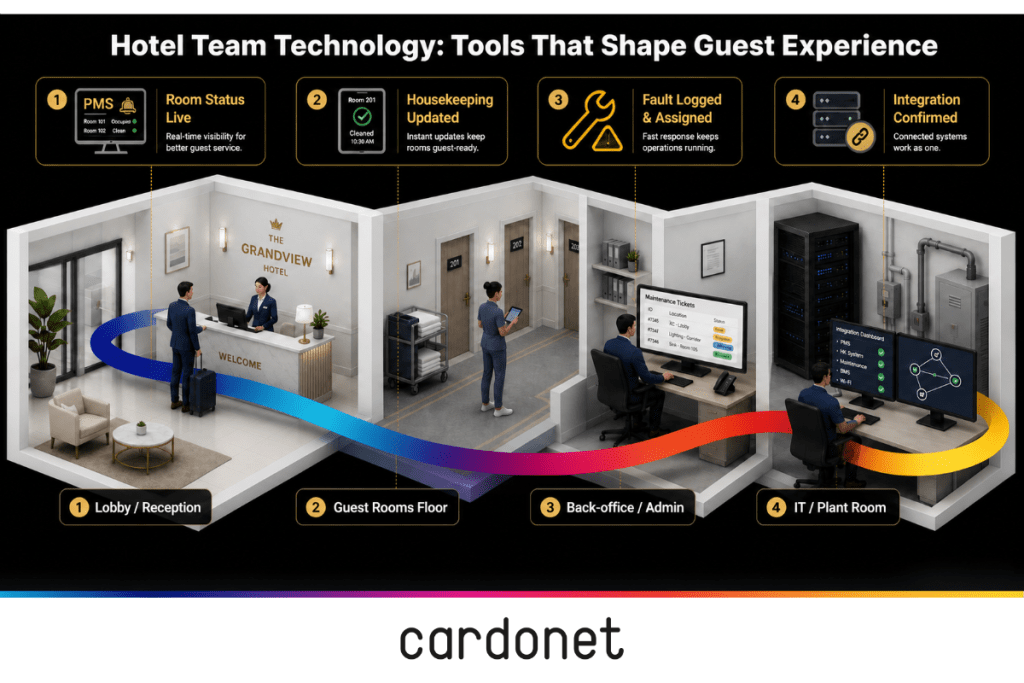
The scenario I see most often goes something like this: a hotel is two weeks from opening, the PMS is configured, the booking engine is live, and the GM is focused on front desk training and the pre-opening press event. The housekeeping management platform was chosen three months ago but the integration with the PMS hasn’t been tested. The maintenance ticketing system is installed but the escalation rules haven’t been set up. The staff communication platform is set up on the supervisor’s device but not rolled out to the full team.
The first week of trading exposes all of it. A room isn’t turned because the housekeeper didn’t receive the departure notification. A maintenance fault logged on day two sits unassigned because nobody configured the routing rules. A guest complaint about a broken shower fitting reaches the front desk, but there’s no record of it ever being raised internally – because it was sent in a personal WhatsApp message that the duty manager has since deleted.
What’s counterintuitive here is that the individual tools are usually fine. The failures almost never come from the software itself, they come from the gaps between systems, the untested integrations, and the team members who weren’t trained before trading began. The honest answer is that most hotel team tech failures in the first month are IT implementation failures, not product failures.
Getting Your Hotel Team Technology Live
The right sequence for implementing team-facing technology in a pre-opening context is different from a standard software rollout. You’re working against a fixed go-live date, training a team that may have never used these tools before, and testing integrations with a PMS that may itself still be in configuration. Here is the approach that works in practice:
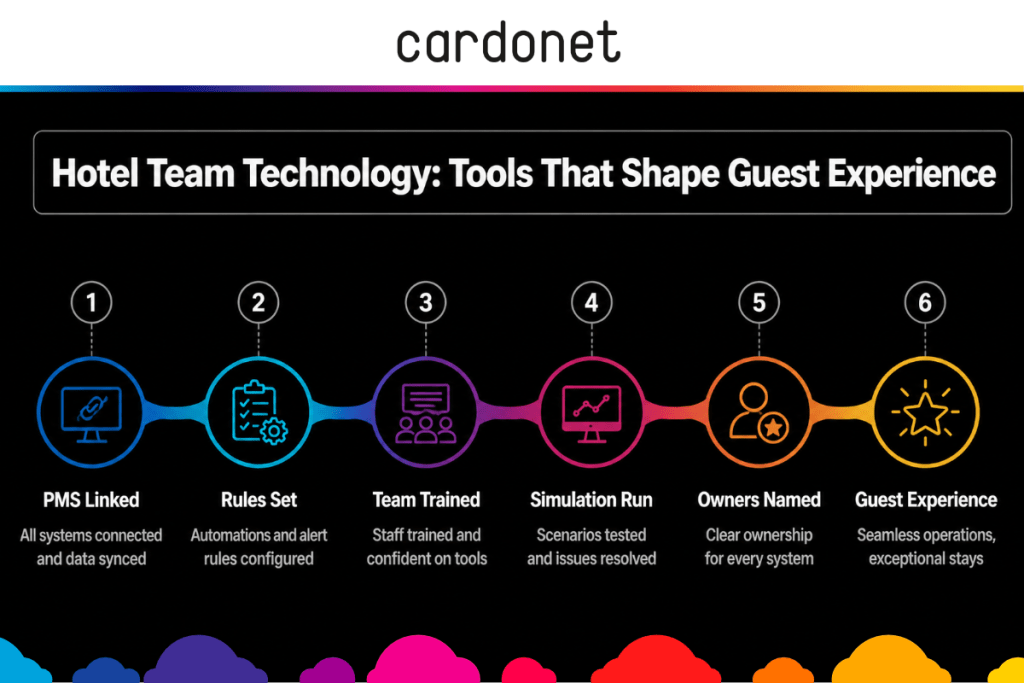
- Confirm PMS integration – before finalizing your housekeeping or maintenance platform, verify that a tested, supported integration exists with your specific PMS version. Not a theoretical integration – a live one, with documentation and a support contact at the vendor
- Configure escalation and routing rules before training – your maintenance ticketing system is useless without rules that determine who receives which fault type, what the response time expectation is, and what happens if a fault isn’t acknowledged within a set period
- Run a full department simulation at least ten days before opening – create test scenarios: a room marked dirty that needs to be turned, a maintenance fault logged at 11pm, a cross-department message that needs acknowledgement from three team members. If the simulation breaks, you have time to fix it
- Train on the tool, not the concept – showing staff a slide about how the housekeeping app works is not training. Put the device in their hand, walk them through the actual task flow, and have them complete a test scenario themselves
- Appoint a single internal owner for each system – the housekeeping supervisor owns the housekeeping platform. The chief engineer owns the maintenance system. The duty manager owns the communications platform. When something breaks, there’s no ambiguity about who picks up the phone
A common objection at this stage is that there isn’t time to do all of this in a pre-opening schedule. In our experience, there’s less time to fix the guest complaints that come from skipping it.
For hotels working with a managed IT support partner, this implementation sequence should be built into the pre-opening IT plan from the outset – not treated as a separate workstream that gets picked up when everything else is done.
What Hotel Team Technology Looks Like Done Right
A hotel that has its team-facing technology properly configured and integrated before opening day doesn’t look dramatically different from the outside. What’s different is what happens invisibly. A room is vacated at 11:07am. The housekeeping supervisor’s device shows the assignment within 30 seconds. The room is cleaned and the status is updated at 12:14pm. The front desk sees it immediately and assigns the waiting guest, without a phone call, message, or manual step in between.
A maintenance fault is logged by a housekeeper at 7:45am – a bathroom extractor fan making a weird noise. The system assigns it to the maintenance team, sets a four-hour resolution target, and flags it to the duty manager. The engineer attends at 9:20am, resolves it, and closes the ticket. If the guest raises the issue at checkout, the front desk can see the full record: logged, assigned, resolved, two hours before checkout.
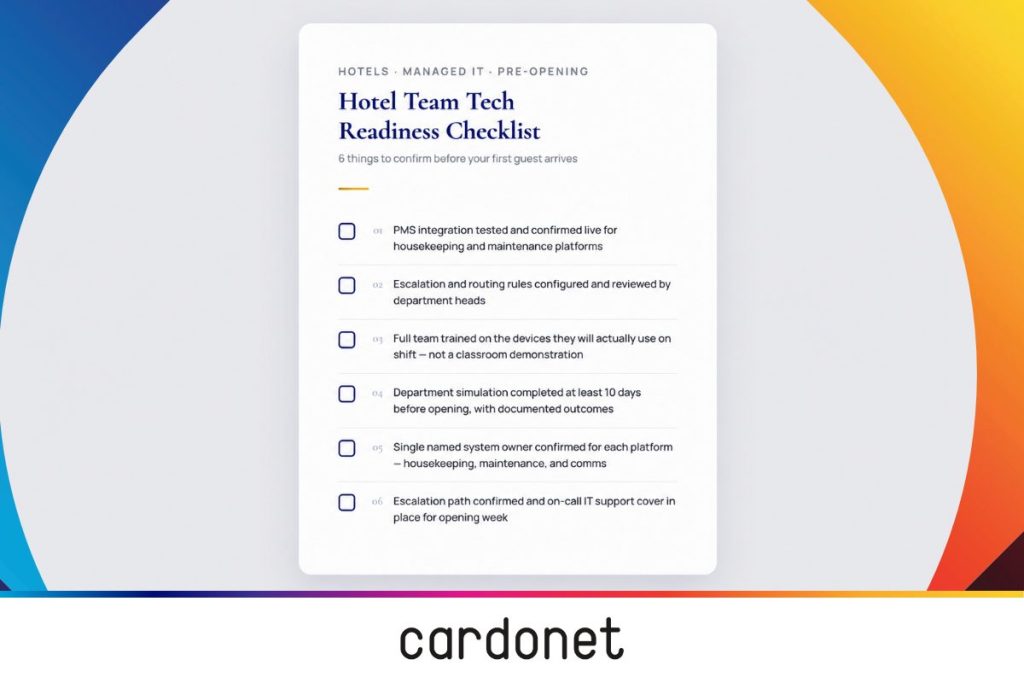
Here is a practical pre-opening team tech readiness checklist to pin to your opening project plan:
- PMS integration tested and confirmed live for housekeeping and maintenance platforms
- Escalation and routing rules configured and reviewed by department heads
- Full team trained on devices they will actually use on shift – not a classroom demonstration
- Department simulation completed with documented outcomes
- Single named system owner confirmed for each platform
- Escalation path confirmed for opening week
The difference between a hotel that opens smoothly and one that spends its first month apologizing to guests is rarely the PMS or the booking engine. The difference comes down almost entirely to the tools the team uses when something goes wrong – and whether those tools were ready before the first guest arrived.
Why This Matters
The business case for getting team technology right before opening is straightforward, but it’s consistently underweighted in pre-opening budgets. Research consistently shows that a hotel’s review score has a direct impact on both occupancy and average daily rate – which means every guest complaint that could have been prevented by a functioning maintenance ticket workflow has a direct revenue consequence, not just a reputational one.
The reputational impact compounds quickly in a hotel’s opening period. Reviews from the first 90 days of trading set the baseline score that future guests use to make booking decisions. A cluster of negative reviews about room readiness or unresolved maintenance faults in week one is genuinely difficult to recover from, because review platforms weight recency and the early reviews anchor the property’s positioning.
Retention matters too – not just of guests, but of staff. Team members who are given tools that don’t work, that haven’t been integrated, and that weren’t properly explained during training lose confidence in the operation quickly. In a sector where hospitality staff turnover runs significantly higher than the UK average, investing in team technology that actually works is also an investment in the people who use it every day.
Protecting Your Hotel: Next Steps
1. Audit your current team tech stack against your PMS – if you’re pre-opening, verify every integration is live and tested, not just selected. If you’re already trading, check whether your housekeeping and maintenance platforms are actually connected to your PMS or running as separate systems.
2. Run a cross-department simulation – create three test scenarios (room turnaround, maintenance fault, cross-department communication) and time them from end to end. Where the process stalls, the technology is either misconfigured or the team hasn’t been trained.
3. Review your opening week IT support cover – the first week of trading is when integrations fail, devices get dropped, and configurations that worked in testing break under real load. Make sure you have a proactive IT support partner who can respond within hours, not days.
If you’re planning a hotel opening or reviewing your team technology ahead of a busy trading period, Cardonet’s hotel IT specialists can audit your back-of-house systems and identify the gaps before your guests do. Speak to the team at cardonet.com.
FAQs: Hotel Team Technology
What is hotel team-facing technology and why does it matter?
Hotel team-facing technology refers to the operational tools used by staff rather than guests – primarily housekeeping management platforms, maintenance ticketing systems, and internal communication tools. These systems determine how efficiently departments coordinate with each other, and poor coordination is one of the leading causes of guest complaints and negative online reviews.
How should hotel team technology integrate with the property management system?
Your housekeeping management and maintenance ticketing platforms should have a live, tested integration with your PMS so that room status updates and maintenance blocks flow automatically between systems. A housekeeping app that requires manual re-entry into the PMS creates double-handling, and in a busy operation, that manual step gets skipped – which means the front desk is working with inaccurate room availability data.
What are the most common hotel team technology failures in the pre-opening period?
The most common failures are untested PMS integrations, maintenance escalation rules that haven’t been configured, and team members who were shown the platform but not trained on the actual task flow they’ll use on shift. These aren’t software failures – they’re implementation failures, and they almost always surface in the first week of trading when the property is under real operational load for the first time.
When should a hotel engage an IT support partner for team technology implementation?
Ideally at the point of platform selection, not after. An experienced hotel IT support partner can verify integration compatibility with your PMS before you commit to a platform, configure escalation rules and routing during setup rather than after go-live, and provide on-site or remote cover during opening week when integrations are most likely to behave unexpectedly under load.
You must be logged in to post a comment.