

The companies building AI data centres are setting the price of AI for everyone else, whether your AI runs in the cloud or on a laptop. Three decisions stay with you: what data your people may use with AI, which licensing terms you accept and what hardware you specify.
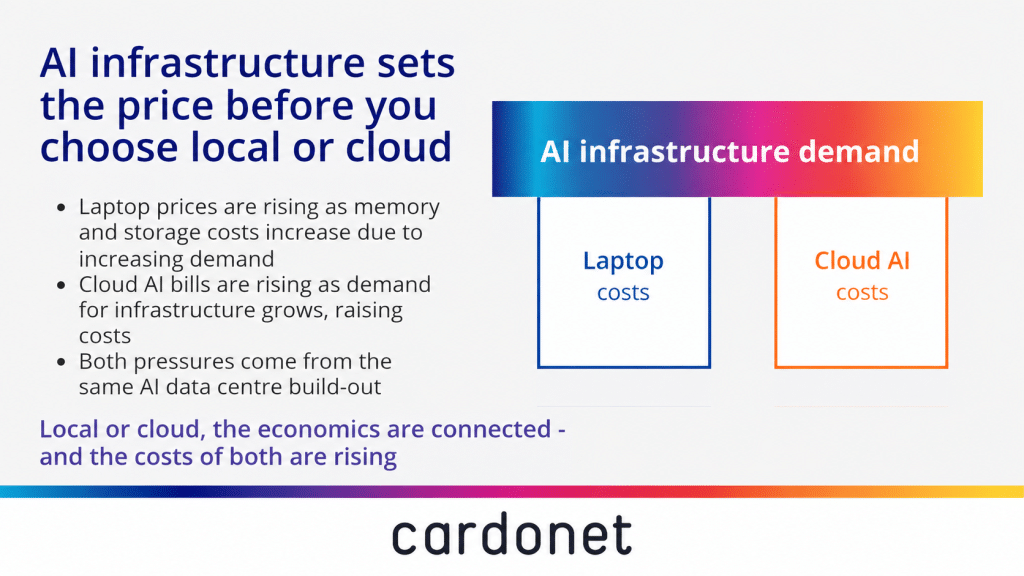
A laptop can look like the way around the cloud AI bill, although the two costs are connected. The firms building AI data centres are buying up so much of the available memory that laptops now cost more, while cloud bills are rising under the same pressure. Any business cloud strategy written in 2026 has to account for both.
Why laptops cost more
Gartner estimates that memory and solid-state storage prices will rise 130% by the end of 2026, lifting PC prices 17% against 2025 and cutting shipments 10.4%. A Gartner analyst told Computerworld in February 2026 that this is a demand-side issue, with the available supply “all going to hyperscalers”, meaning the largest cloud providers. That puts the cloud build-out behind the price of the laptops you would run AI on.
Why cloud AI bills are rising
Your cloud bill faces the same demand. Gartner forecasts that spending on infrastructure as a service built for AI will grow 96% in 2026 to $42 billion USD, and that inference will take 55% of it in 2026 and 59% in 2027. Inference means running a trained model each time someone asks it something, so every question your team puts to a cloud AI tool adds to the meter.
Gartner also predicts that AI inference costs per agentic workflow (a task an AI system carries out in several steps on its own) will rise more than fivefold through 2028, even as model prices fall. In the UK, the House of Commons Library reported in May 2026 that data centres use an estimated 2.5% of UK electricity. The National Energy System Operator expects their consumption to climb from 7.6 terawatt hours to between 20 and 41 by 2035, the report adds.
When to buy
That makes your next laptop order a question of when to buy and which specifications are worth paying for.
The same Gartner analyst said in February 2026 that prices would stay high almost to the end of 2027 and that whatever you buy now will probably be the best price available. Vendors, the analyst added, were holding a quote for only two or three weeks. IDC (International Data Corporation) sees no relief in the memory shortage before the end of 2027.
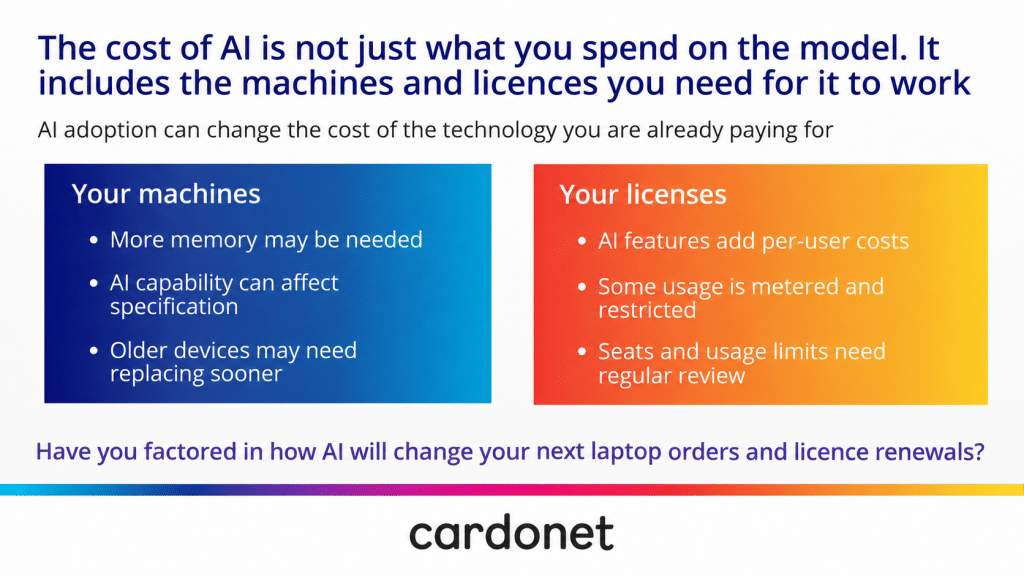
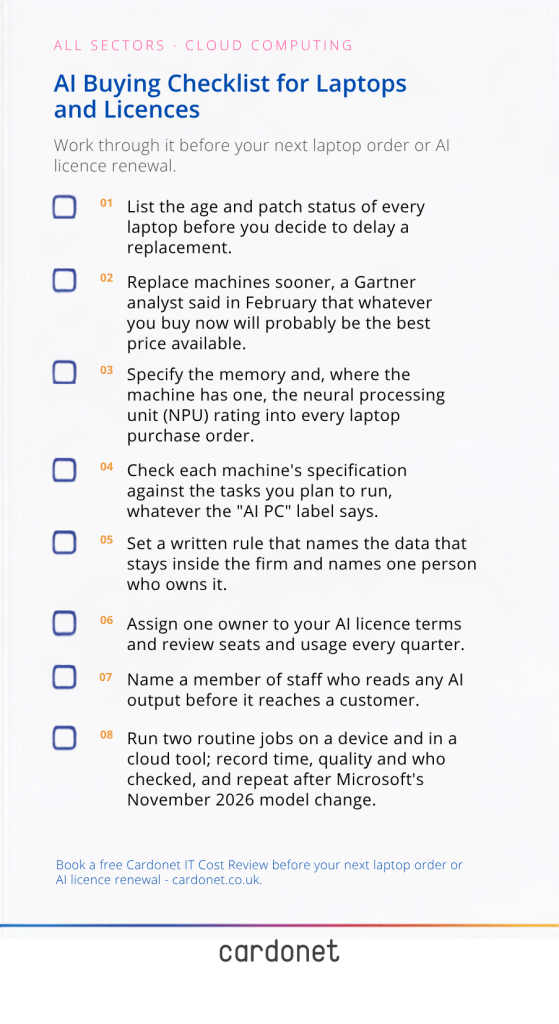
Waiting has a cost of its own. Gartner expects business PC lifetimes to stretch by 15% in 2026 and warns that delayed upgrades bring more security vulnerabilities and harder management of older devices. On that evidence I would replace machines sooner, and before you decide to delay, I would want the age and patch status of every laptop in front of you.
What to ask for on the quote
Once you decide to buy, the open question is how much AI capability to pay for. Microsoft defines a Copilot+ PC by its hardware: a neural processing unit (NPU, a chip built for AI tasks) rated at 40 or more trillion operations per second, plus 16GB or more of memory. An IDC analyst told The Register in January 2026 that some machines could carry the “AI PC” label with less than 16GB, using a hybrid approach where some work runs on the device and most runs in the cloud.
Ask for the memory in gigabytes and, where the machine has one, the NPU rating on every purchase order, in writing. Our IT procurement team can check a specification against the tasks you plan to run.
What runs on the device today
On-device AI runs small models for set tasks. Microsoft’s on-device model, Phi Silica, handles summing up, rewriting and turning text into tables, and Microsoft’s note tells developers to keep human oversight on high-stakes decisions. Apple says its on-device model, at about 3 billion parameters, is built for tasks such as summing up, pulling out names and details, refining text and short dialogue, although answering general questions from world knowledge lies outside that design. Apple also describes on-device inference as free of cost to app developers, though the device itself still carries the price rises above.
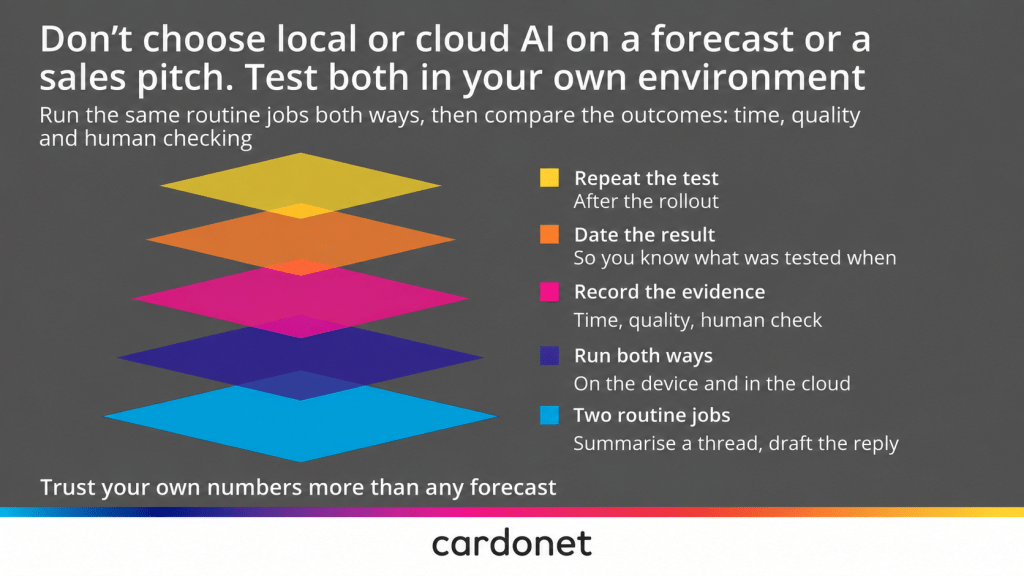
These models change quickly. Microsoft’s own page says it is replacing Phi Silica with a new on-device model, Aion Instruct, with retail rollout due in November 2026 . If you test the Windows on-device model before then, date every result and repeat the test after the rollout.
Set a data rule
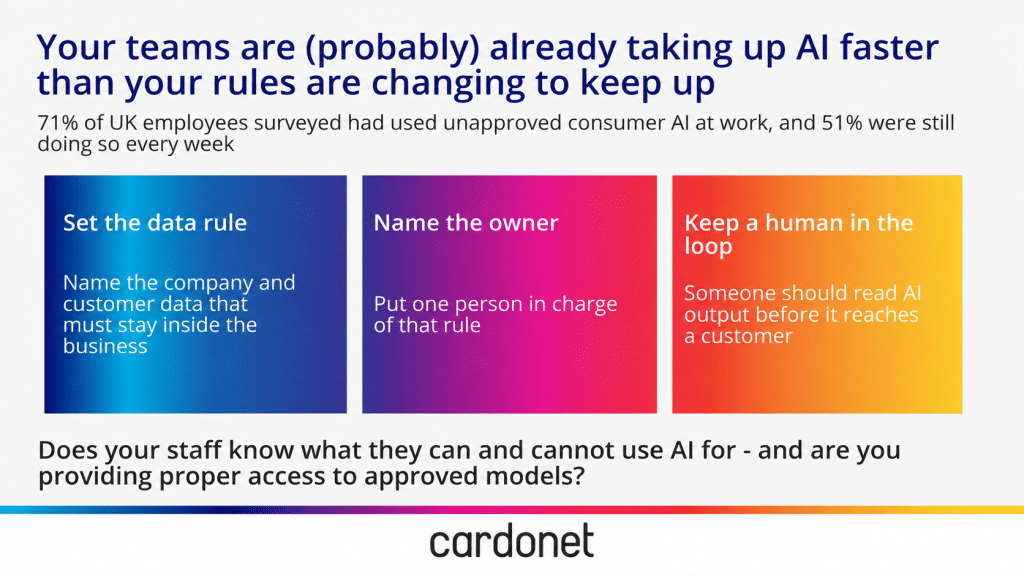
Start with the data your people may use. Research commissioned by Microsoft and run by Censuswide among 2,003 UK workers in October 2025 found that 71% had used unapproved consumer AI tools at work, and 51% still did so weekly. Only 32% were concerned about the privacy of company or customer data they put into those tools. Because the research comes from a vendor, weigh the figures with that in mind.
The Information Commissioner’s Office notes that data protection law is technology neutral and covers AI wherever it uses personal data, so your obligations are the same whether the model runs on a laptop or in a data centre. Put the data that must stay inside the business in a written rule and name one person who owns it. We can help you draft that rule as part of our data protection compliance work.
Watch the licensing terms
Microsoft prices its Copilot plan per person per month on an annual term, while metering some usage, such as agent use on its no-cost chat tier. A per-seat fee is easy to forecast, whereas metered use rises with every task. Gartner predicts that by 2029, 60% of those deploying AI will set up a dedicated function to track AI cost against value. A named owner and a quarterly review of seats and usage will keep that cost visible in the meantime.
Test on your own tasks
Before you buy on any label, test on your own work. Pick two routine jobs, such as condensing a long email thread and drafting the reply, and run each on a device and in a cloud tool. Record the time taken, the quality and who checked the output, and make sure a named person on your team reads any AI output before it reaches a client.
Before your next order
The Windows on-device model changes in November 2026, while memory prices are expected to stay high through 2027. Before your next laptop order or licensing renewal, decide which matters more to you: waiting for the new on-device model, or limiting your exposure to older hardware and rising prices.
The published evidence doesn’t yet settle whether local or cloud AI works out cheaper, so give your own pilot numbers more weight than any forecast in this article.
Book a free Cardonet IT Cost Review before your next laptop order or AI licensing renewal, and we will go through the specification and the licensing terms with you.
FAQs
Will running AI on our own laptops save us money?
The published evidence doesn’t settle whether local or cloud AI works out cheaper. Apple describes on-device inference as free of cost to app developers, but the device still carries the memory-driven price rises that Gartner and IDC (International Data Corporation) forecast. A pilot on two routine jobs, run on a device and in a cloud tool, gives you numbers to weigh above any forecast.
Is it worth waiting for laptop prices to come down?
A Gartner analyst said in February 2026 that prices would stay high almost to the end of 2027, and IDC sees no relief in the memory shortage before then. Waiting can still make sense for healthy, fully patched machines, although Gartner warns that delayed upgrades bring more security vulnerabilities and harder management. List the age and patch status of every laptop first, then buy sooner for any machine already due for replacement.
What should we ask for on a laptop quote if we want AI on the device?
Ask for the memory in gigabytes and, where the machine has one, the neural processing unit (NPU) rating, in writing. Microsoft’s Copilot+ definition calls for an NPU rated at 40 or more trillion operations per second and 16GB or more of memory. An IDC analyst told The Register that some machines could carry the “AI PC” label with less than 16GB, so the badge alone tells you little.
Is it safer to keep our data on our own laptops than in a cloud AI tool?
The Information Commissioner’s Office treats the two alike, stating that data protection law is technology neutral and covers AI wherever it uses personal data. Your obligations are the same whether the model runs on a laptop or in a data centre, so write down which data must stay inside the business and name one person who owns that rule.
How do we keep AI licensing costs under control once our team starts using it?
A per-seat fee is easy to forecast, while metered use such as agent activity rises with every task. Give one named person ownership and review seats and usage every quarter. Gartner predicts that by 2029, 60% of those deploying AI will set up a dedicated function to track AI cost against value.
More from Sagi Saltoun
- The Triple AI Threat: Data Leaks, Hallucinations, and the Trust Crisis
- Privacy Without a Fortress: A Practical Confidentiality Model for Private Offices
- Cybersecurity and operational excellence
- Uptime Without a Headquarters: Resilience for a Private Office That Never Stops Moving
- The Hidden Truth About Hotel IT Budgets


You must be logged in to post a comment.