
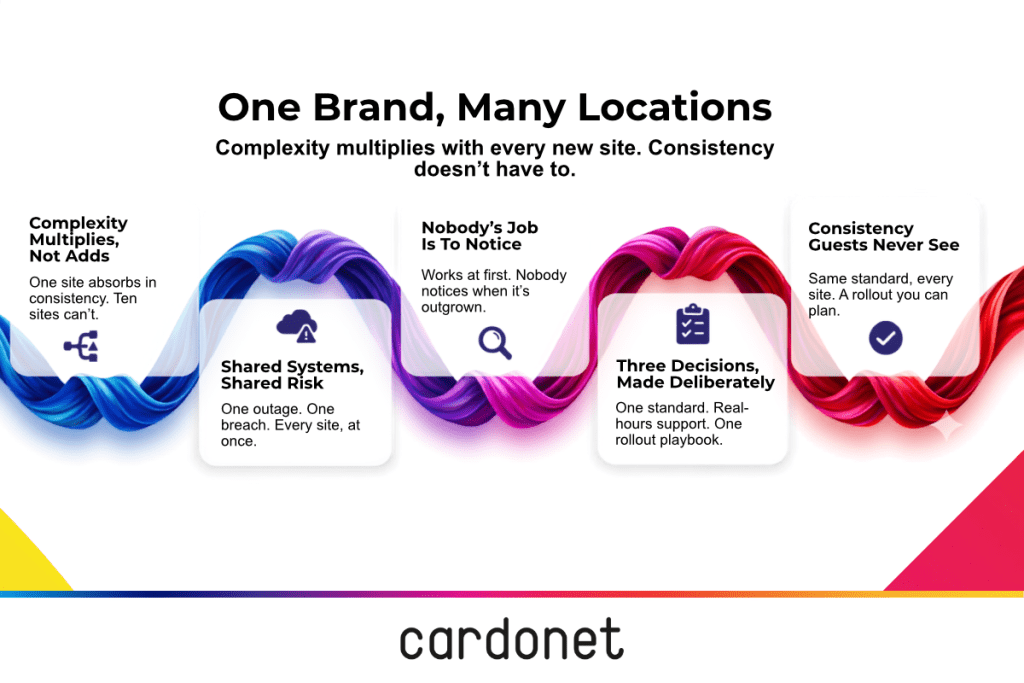
When a card terminal stops responding at one site during a Saturday dinner service, the first question is rarely about the terminal itself. It’s whether the fault is local, some loose piece of hardware on site, or something shared across the network that’s about to surface at every other site running the same setup. Multi-site restaurant IT gets harder with every new opening because complexity multiplies rather than adds. Each location runs its own version of every system, and small inconsistencies between sites compound faster than headcount grows. A single restaurant can absorb that kind of problem. A ten-site group can’t, not without a plan.
Most restaurant groups don’t consciously design how technology gets deployed as they scale. Each new site tends to copy roughly what the last one had, with small variations introduced by whichever supplier was available, whatever hardware was in stock, and whoever happened to configure it. Nobody decides this is how the estate’s IT will work. It just accumulates.
Why the Second Site Isn’t Just “One More Site”
Open a second restaurant and headcount, rent, and stock orders roughly double. Every platform the group runs – point of sale, kitchen display, reservations, online ordering, guest Wi-Fi, payment processing – now exists in two versions instead of one. Each version needs its own restaurant network infrastructure, its own configuration, and its own local quirks worked out by whoever happened to install it.
By site five, a group is managing five slightly different versions of the same technology stack. None of them were built to match the others, because nobody set a standard early enough for it to matter. The next section shows exactly where that gap turns into real operational cost.
Where the Complexity Actually Multiplies
Three pressure points tend to show up first as a restaurant group scales, and a fourth becomes more serious the wider the estate gets.
Shared infrastructure, shared exposure
Restaurant groups increasingly run POS, ordering, and reporting through the same cloud platforms and the same internet connections across every site. That’s efficient when everything’s working. When a provider goes down, however, every connected site goes down with it. When AWS went down for several hours in October 2025, several major restaurant brands felt it: McDonald’s app users hit disruptions, Starbucks customers couldn’t pre-order, check rewards, or use mobile pay, and DoorDash orders failed outright. The same risk applies to any group that centralises on one cloud provider without a backup.
Integration debt
A single restaurant typically has three systems talking to each other: the POS, a delivery platform, and the accounting package. That’s three connections to keep working. A group running ten sites on the same setup has thirty – and each one can break on its own and someone spends an afternoon checking ten different dashboards to find out where. EHL Hospitality Business School’s 2025 Global Foodservice Outlook, surveying over 1,200 foodservice operators worldwide, found that innovation and digital capability are advancing across the sector largely in isolation rather than as one connected system.
For a multi-site restaurant group, that gap shows up as duplicated effort at every location instead of one. Rarely does this show up as a single dramatic failure. More often it’s a slow accumulation of small breakages nobody has time to trace back to a root cause.
The support model breaks first
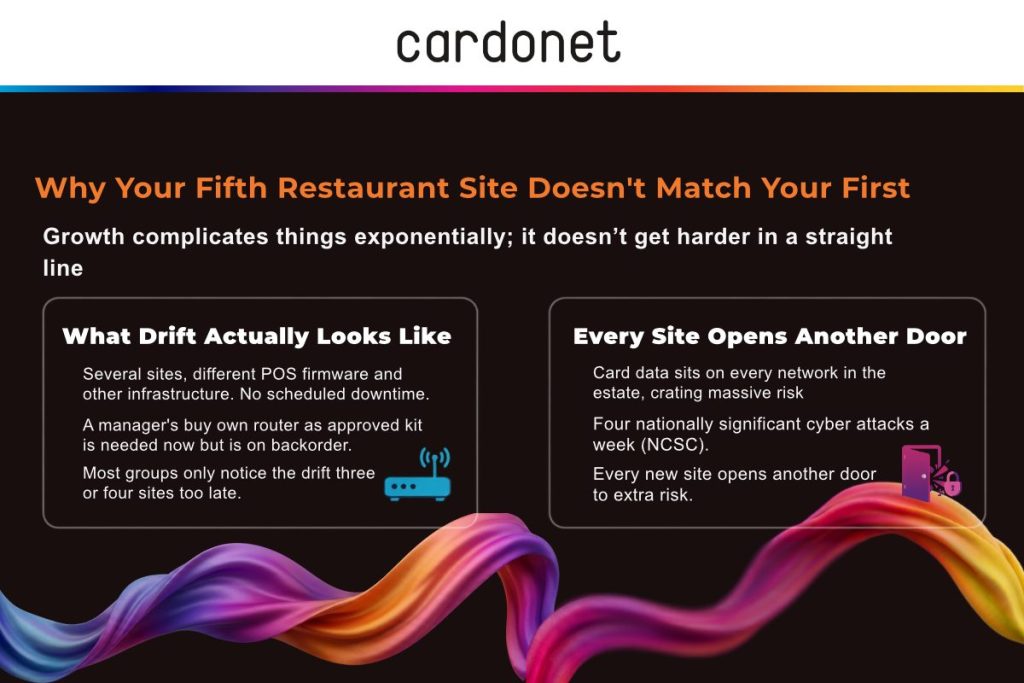
At one or two sites, the manager who “knows computers” and a local supplier on speed dial can get a group through most problems. That model doesn’t scale much beyond a handful of sites; the cracks show up in the small things first such as two sites running different POS firmware versions because nobody wanted to schedule downtime for the update, or a manager quietly buying their own router off Amazon because the group-approved one was backordered.
A wider attack surface
More sites mean more payment terminals, more staff logins, and more networks to secure. For a restaurant group handling card data at every till in every location, that risk scales with the estate. None of the fixes below are optional once card data is involved at every site.
The Infrastructure Decisions That Keep Scaling Smooth
Multi-site growth gets easier when group-wide decisions are made deliberately, before problems force the issue. The groups that handle this well are rarely the largest or best-funded, a nine-site QSR chain can easily have a tighter standard than a fifty-site casual-dining group still running three different POS vendors depending on which region opened first.
Build one configuration standard, not eleven
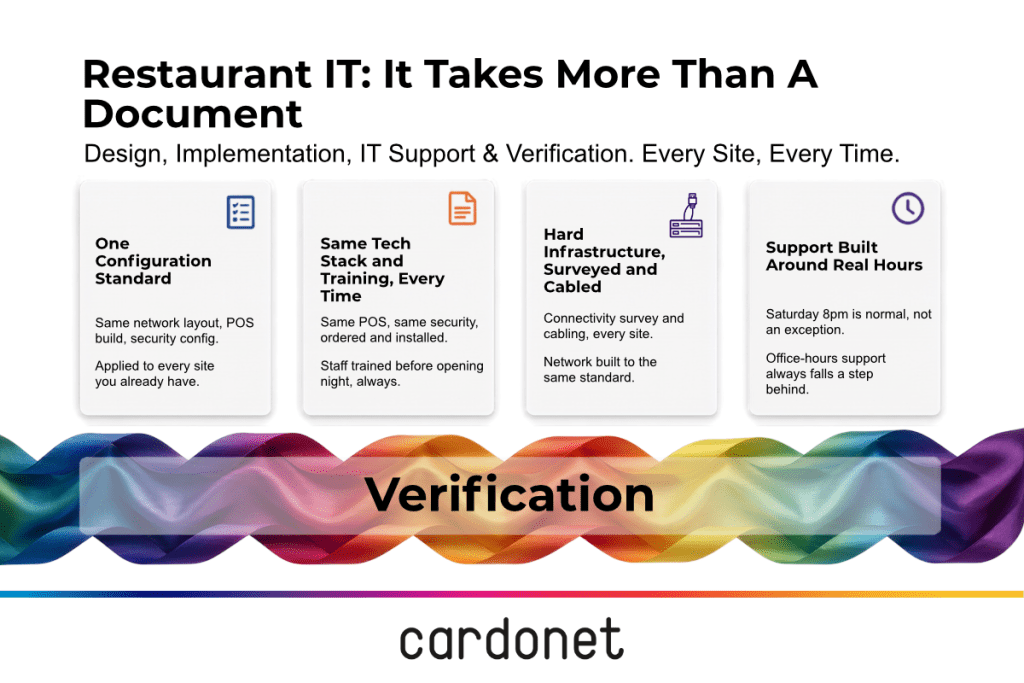
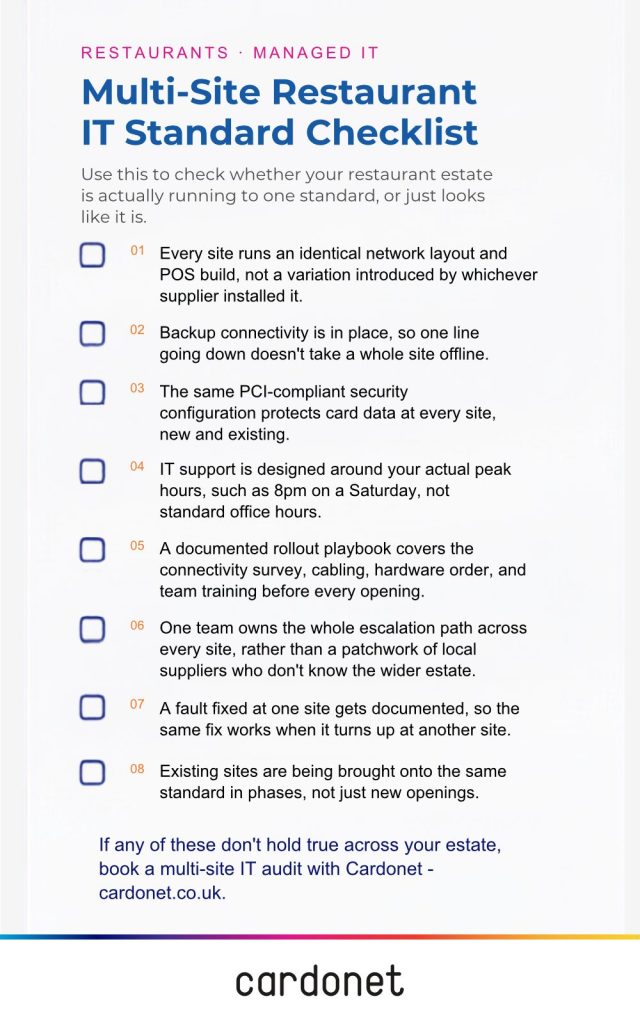
Every new site should run from the same documented baseline. That means:
- Identical network layout and POS build
- Backup connectivity so one line going down doesn’t take the whole site offline
- Standard integrations into delivery and accounting instead of ad hoc ones, and the same PCI-compliant security configuration protecting card data everywhere.
When something breaks at site nine, the team already knows the answer, because they fixed the same fault at site three.
A single point of accountability can replace the patchwork of local suppliers who each only know their own corner of the business if one team owns the whole escalation path and already knows every site’s setup.
Design for 24/7 IT support from the start
Peak service happens at 8pm on a Saturday, not 10am on a Tuesday. A support model built around office hours will always be a step behind a restaurant group trading seven nights a week across a dozen postcodes. That’s why 24/7 IT support needs to be part of the design from the first site.
Write the rollout playbook once
A documented, repeatable process for opening a new site – the connectivity survey, the cabling, the hardware order, getting the team trained before day one – turns every new opening into a known quantity.
Applied to the Saturday-night card terminal example from the start of this article: in a group that’s standardised its configuration and centralised its support, the fault gets diagnosed in minutes, because the fix is already documented and the team already knows the site’s setup. In a group that’s improvised its way to a dozen locations, that same fault stays a mystery for considerably longer.
What Smooth Scaling Actually Looks Like
Get this right and multi-site restaurant IT growth stops being a growing liability. A new starter learns one system rather than a different variant depending on which site they get sent to cover. Managers spend service periods managing service rather than IT issues. Technology decisions made at site three don’t have to be unpicked and rebuilt by the time the group reaches site thirty. That consistency is invisible to guests, but it’s what keeps their experience consistent across all locations.
That consistency comes from treating the technology estate the way a group treats its brand: designed deliberately and managed actively everywhere the brand operates. That matches a wider shift already underway that is seeing
Most groups only find out their setup isn’t standardised at the worst possible time. Cardonet audits multi-site restaurant groups’existing IT and builds the restaurant technology support and standardised infrastructure that keeps every new opening as simple as the first. Better to do this on a quiet Tuesday than try fix it on a Friday night.
FAQs
1. How many sites before our restaurant group needs a different approach to IT?
There’s no fixed trigger point, but in my experience with casual-dining groups, the strain usually shows by the time you’re running ten or more sites on an informal setup – different POS firmware versions, a manager’s own router standing in for the approved one. The smarter move is writing the configuration standard down while it’s still simple, rather than waiting until every site has gone its own way and retrofitting becomes the only option.
2. We already use a mix of local suppliers across our sites. Is it worth consolidating to one IT partner?
Usually, yes. A single team that already knows every site’s setup can diagnose a fault at site nine because they fixed the same one at site three – try getting that from three different local suppliers who’ve never spoken to each other.
3. What’s the first thing we should fix if our restaurant sites are all configured differently?
Start with a single documented baseline covering the network, the POS build, and how guest Wi-Fi is segmented from the rest of the system – the same baseline every site, new and existing, gets measured against. Sites that already deviate can be brought into line gradually, but without that baseline written down, every fix stays a one-off.
4. Does standardising our IT setup mean every site has to be identical?
Standardising covers the network, the POS build, and the support model – not the floor plan or the menu. A team member trained at one site should recognise the same POS screens and network setup at another, whatever the building looks like.
5. How quickly can Cardonet get a multi-site restaurant group onto a standard IT setup?
Most of the work happens before a single till is plugged in: surveying the site’s connectivity, running the cabling, getting hardware ordered and the team trained ahead of opening night. None of that changes much between a group’s fifth site and its fiftieth, which is exactly what keeps rollout timelines predictable as the group grows. Existing sites can be brought onto the same baseline in phases, so operations don’t need to pause to make the switch.
You must be logged in to post a comment.