
A hotel feasibility model can balance perfectly on paper and still be wrong, because the ongoing IT support line rarely gets the scrutiny the rest of the budget receives. Every lender and investor in the room will stress-test room count, ADR projections, construction cost per key, and F&B revenue assumptions. They don’t generally pay the same attention to hotel technology budgets, despite this running at just over 4% of revenue in the most recent industry survey data. A meaningful share of that figure is the ongoing cost of running the systems, not the initial build, yet most feasibility studies stop at pricing the build. The gap between what gets modelled and what actually gets spent is where otherwise sound hotel projects can run into trouble in year one.
Why Hotel IT Support Costs Get Underestimated in Feasibility Models
The root problem is structural. Feasibility studies are built by teams who think in terms of capex and opex, and IT support doesn’t sit cleanly in either one. The original PMS licence, the network cabling, the server room build-out get costed as one-off capital spend because they’re procured once, during construction. What doesn’t get costed with the same rigour is the ongoing work needed to keep those systems running optimally: the help desk, the monitoring, the vendor management across a dozen integrated platforms, and the security patching that never stops.
Part of the problem is a wider pattern in how feasibility studies get built. Reviews of feasibility methodology point to a recurring failure to weight operational factors such as zoning, permitting timelines, and demand fluctuations as heavily as the financial projections they feed into. IT support sits in the same blind spot. It’s operational detail rather than a headline financial projection, so it rarely gets the same scrutiny before a model is signed off.
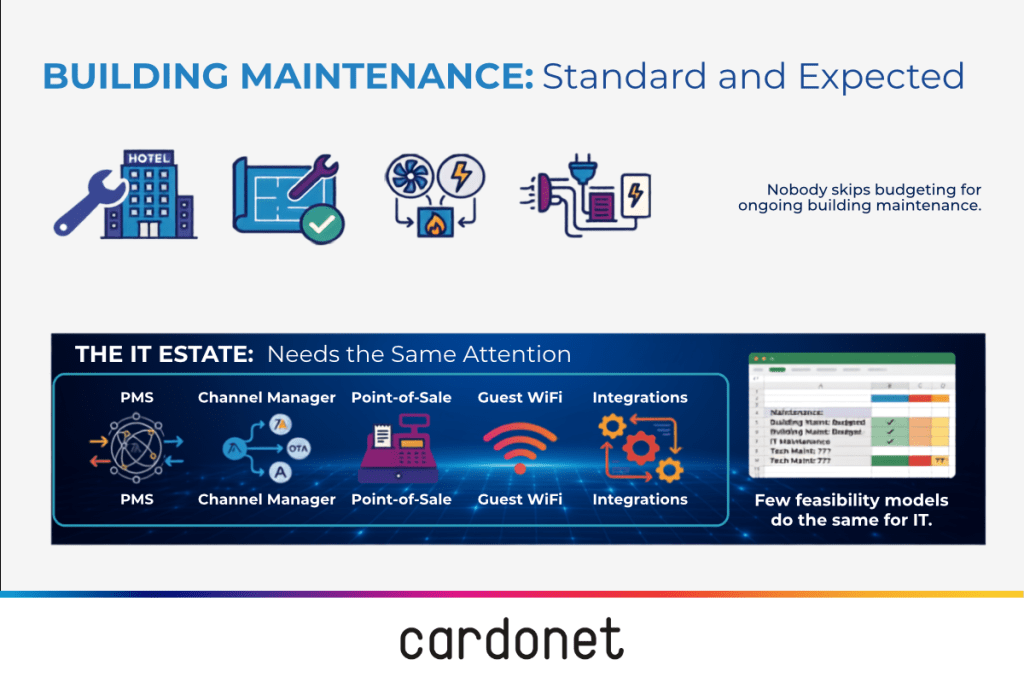
Once a hotel opens with a PMS, a channel manager, a point-of-sale system, guest WiFi, and a handful of smaller integrations, it has effectively built a small, mission-critical technology estate. Nobody would open a hotel without budgeting for maintenance staff to keep the building running. Few feasibility models apply the same logic to the IT systems that keep the booking engine and the payment terminals running.
What Realistic IT Costs Look Like, By Hotel Type
Recent survey data gives a workable anchor. Hospitality Technology’s most recent Lodging Technology Study puts overall hotel IT budgets at just over 4% of revenue. That figure blends everything: software licensing, ongoing support, and IT staff time where a property carries any. It’s a useful basis for the conversation, but it doesn’t say how that spend splits by property type, which is the number a feasibility model actually needs.
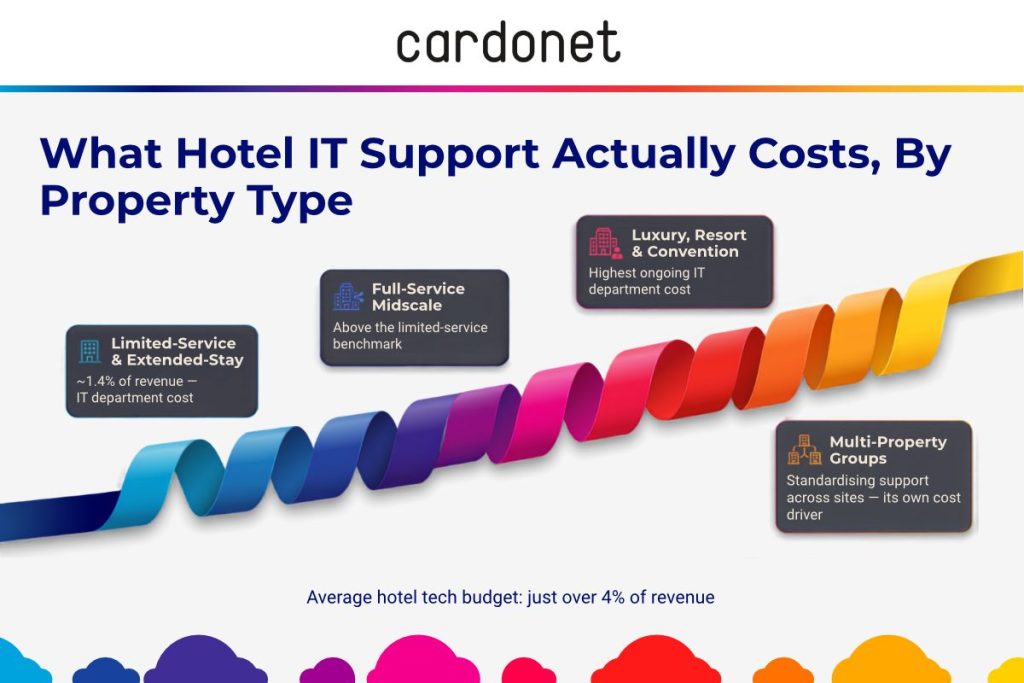
For that split, industry analysis of hotel IT department expenditure is more precise. Limited-service and extended-stay properties average around 1.4% of revenue on IT department costs, the line that captures day-to-day support rather than one-off capital spend. Resort and convention hotels run meaningfully higher, in large part because they’re the property types most likely to justify dedicated technology staff on-site. That’s the number a feasibility model tends to miss: not the PMS licence, which gets quoted early, but the ongoing departmental cost of keeping everything running.
Software procurement has a natural home in the plan because a PMS vendor’s quote arrives early and slots into the capex line regardless of how support ends up being delivered later, whether that’s an in-house engineer, a managed provider, or a mixed model between the two. Support itself has no equivalent moment: the support delivery decision typically gets made after the feasibility numbers are already set, so it never makes it into either line.
Applying this by hotel type gives a workable planning framework:
- Limited-service or budget properties carry the lightest ongoing IT department cost, close to the 1.4% of revenue benchmark, but run a leaner stack (PMS, channel manager, basic network and WiFi) with less internal capacity to absorb a support gap when something breaks.
- Full-service midscale hotels carry more integration points: POS across multiple outlets, spa or leisure booking systems, heavier guest WiFi demand. These properties tend to sit above the limited-service benchmark, where consolidation discipline matters most.
- Luxury, resort, and convention properties run the highest ongoing IT department costs, largely because they’re the segment most likely to carry dedicated technology staff, guest-facing systems, and higher guest-data volumes, pushing support requirements up before compliance costs are even added.
Multi-property groups sit outside this scale entirely. The ratio might look manageable at any single hotel, but standardising support across sites, so a fix at one property doesn’t need reinventing at the next, becomes its own cost driver that a single-property feasibility model was never built to capture.
Smaller operators are the least likely to carry a dedicated IT department budget line in the first place, which means more variance in what their tech stack actually looks like, less internal capacity to catch a support gap early, and more exposure when an unplanned cost lands. A feasibility model built around a single “typical hotel” assumption will misfire for most of the properties that actually get built.
Why This Matters Specifically at the Feasibility Stage
Getting the support number wrong changes how a lender or investment committee reads the whole project. Feasibility studies exist to give lenders and investors a defensible basis for approving capital, and an unbudgeted cost is a gap a diligent underwriter will eventually find. In practice that gap tends to surface as an unexplained “IT services” invoice three or four months after opening, or a scramble to explain why nobody budgeted for the WiFi monitoring contract the installer quietly assumed the hotel would sign.
A support model bolted on after opening is also more expensive than one planned at the feasibility stage. Retrofitting monitoring and escalation paths into a live, trading hotel means working around occupied rooms and operating staff: patch windows shrink to the hours between last checkout and first check-in, and a vendor called out on short notice charges for the privilege.
As Cardonet’s hotel IT consultancy work on budgeting and cost control sets out, supportability is a selection criterion at the design stage, not a problem to solve later. Budgeting is the other half of that decision: you can’t compare the cost of keeping support in-house against handing it to a managed provider, or landing somewhere in between, without first knowing what each path costs to run.
Putting a Realistic IT Support Line Into the Business Plan
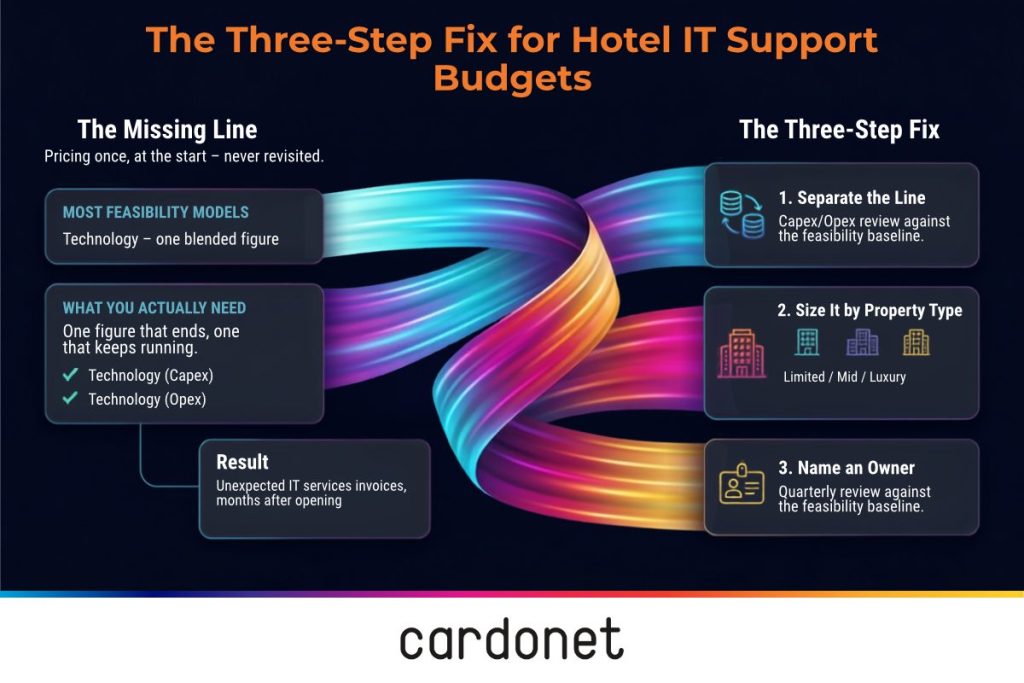
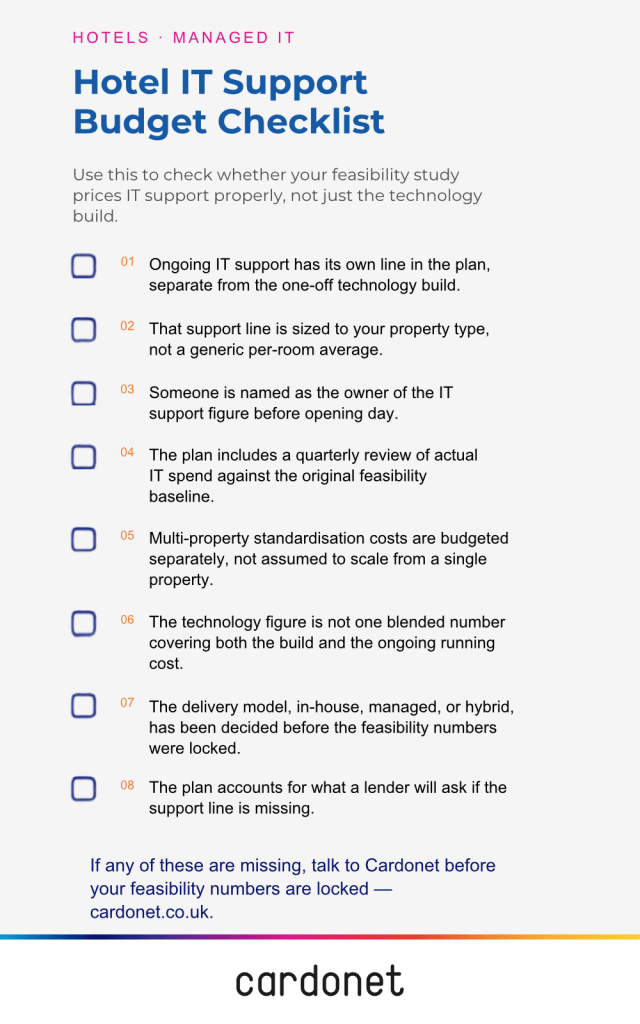
A feasibility model that treats hotel IT support seriously needs to go beyond listing technology as a line item. Sizing the support figure against property type, rather than a generic per-room average, is the starting point, since the number of integrated systems drives support workload more than the number of beds does.
That figure then needs an owner. A number nobody is accountable for quietly stops being checked against reality once the hotel is trading. Naming that owner before opening day is also what turns a review point into something real rather than symbolic: a quarterly check of the actual IT spend line against the original feasibility baseline, not an annual budget rubber-stamp, is enough to catch drift before it compounds. Technology costs shift as brand mandates change and as new revenue streams like spa or events get added; someone has to notice when they do, and adjust the number accordingly. Ongoing IT cost optimisation work is what keeps the figure accurate as those changes happen.
Planning support costs this way pairs naturally with designing your hotel’s technology infrastructure before you break ground: the physical build and the support model that keeps it running are best planned together, not one after the other.
Getting the Number Right Before You Need It
Hotel IT support costs aren’t inherently hard to predict. Most feasibility models simply never ask the question in a form that produces a usable number, so the figure that ends up in the plan is whatever a vendor happens to quote first, not what the hotel will actually need to run in the years after opening. That’s not a knock on the people building these models: capex is simply easier to picture than an us-yet unsigned support contract. Sizing the number against hotel type and system complexity, and giving it an owner from day one, is what closes that gap.
If you’re building a feasibility study or business plan and want a realistic support figure to work from, Cardonet’s hotel IT consultancy team can help model that cost against your specific property type before you’re committed to numbers you don’t fully understand.
FAQs
1. How much should I budget for hotel IT support in a feasibility study?
Recent industry survey data puts overall hotel technology budgets at just over 4% of revenue, but the ongoing IT department cost specifically averages around 1.4% of revenue at limited-service and extended-stay properties, rising at resort and convention hotels that carry dedicated technology staff. Use the figure that matches your property type rather than a single blanket number.
2. Why doesn’t my feasibility study already include IT support costs?
Most feasibility models cost technology as a one-off capital item, covering the PMS licence, cabling, and server room build-out, because that’s what a vendor quote naturally itemises. Ongoing support has no equivalent invoice at the planning stage, especially when the in-house, managed, or hybrid decision hasn’t been made yet, so it tends to fall out of the model entirely.
3. Does the IT support budget change if I’m running a multi-property group rather than a single hotel?
Yes. A single-property feasibility model can’t capture the cost of standardising support across sites, so that a fix at one hotel doesn’t have to be reinvented at the next. That standardisation work is its own cost driver and needs modelling separately from the per-property ratio.
4. Should IT support costs be treated as capex or opex in my business plan?
Support should sit in opex, as a recurring annual cost, separate from the one-off capex for systems and infrastructure. Keeping the two lines apart is what lets a lender or investment committee see the real ongoing cost of running the hotel, rather than a single blended technology figure that understates it.
5. Who should own the IT support budget once the hotel is trading?
Someone needs to be named as accountable for the figure before opening day, with a quarterly check of actual IT spend against the original feasibility baseline rather than an annual rubber-stamp. That owner is also who should flag when new revenue streams, like spa or events, add integration complexity the original budget didn’t account for.
You must be logged in to post a comment.