
When you secure a franchise with a major hotel brand, you sign up to an enormous number of operational and technology requirements. That’s a given. These shape integration complexity and support costs, but their impact on security and other IT architecture is often overlooked. If you focus only on brand compliance, PMS choice and WiFi performance, you can still open with a network that is harder to secure, more expensive to support, and wider in PCI-DSS scope than it needs to be.
Once a franchise agreement fixes the systems you must run, it also influences how data moves between reservations, front desk, payments, loyalty, guest WiFi and back-office operations. That is where security risk appears, and it is why hotel franchise technology requirements should be treated as an infrastructure decision, not a procurement checklist.
I see the same mistake repeatedly in hospitality projects. Owners ask whether the mandated systems meet brand standards. They ask far less often how those systems affect PCI-DSS scope, third-party access, firewall policy or long-term support costs. That gap matters more than most people think.
The systems that matter
Most hotel franchise agreements impose technology requirements across four areas: the property management system, point of sale, guest connectivity and loyalty or central booking integration. Those choices are not isolated. They create the operating environment your hotel has to live with every day.
A mandated PMS does more than run check-in and check-out. It exchanges data with reservation systems, payment tools, room-status workflows, guest-facing services and reporting platforms. The more tightly those systems are connected, the more carefully the surrounding network needs to be designed.
That is the part too many owners miss. A newer cloud platform may reduce training time and improve usability, but it does not remove the need for secure API connections, clear access rules or disciplined segmentation between guest, operational and payment traffic.
In plain terms: brand-approved platforms can create messy security architecture if the underlying network has not been designed properly.
Where hotels get exposed
PCI-DSS expects organisations to control and limit the environment that handles payment data. Network segmentation is a major part of that. The PCI Security Standards Council’s guidance is clear that segmentation can reduce PCI-DSS scope and help contain the impact of a compromise.
Brands generally assume this has been addressed. They specify service levels, brand standards and required platforms. They do not usually dictate the full security design underneath.
That leaves owners with more responsibility than they often realise.
A typical hotel problem is not exotic. Guest WiFi sits too close to operational systems. Payment terminals and office machines have broader network access than they should. Building systems such as locks, CCTV or climate controls are added with convenience in mind, then left on parts of the network that were never designed to carry that level of risk.
This is how PCI scope expands quietly. It is also how a hotel ends up with a network that is difficult to support, expensive to audit and dangerous to troubleshoot under pressure.
The network you actually need
The simplest way to think about a hotel network is as three separate environments.
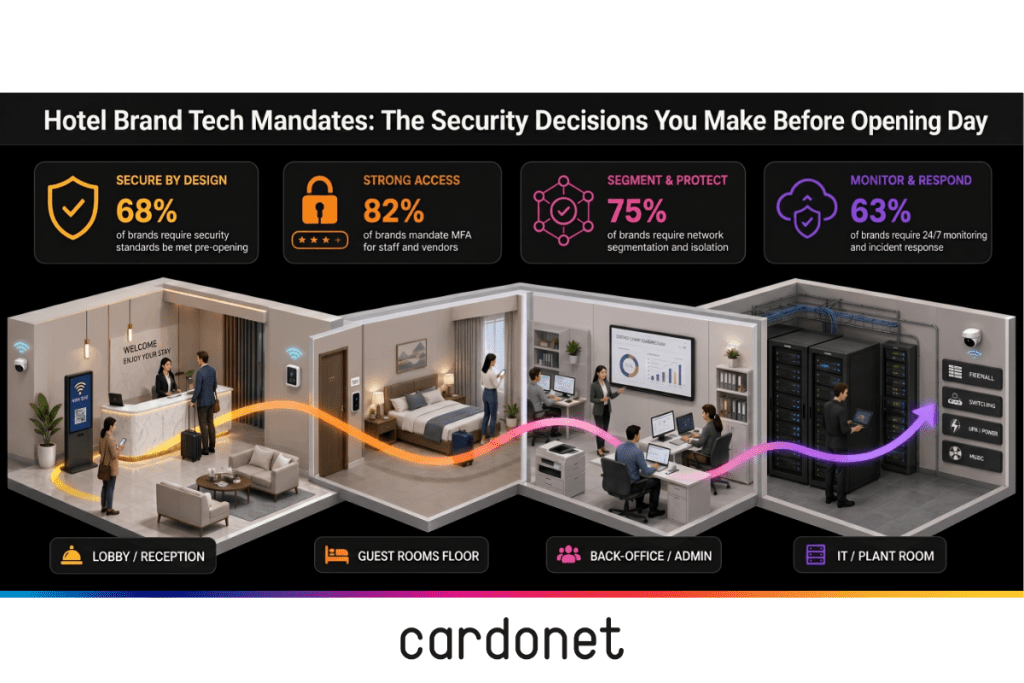
Guest services come first. WiFi, captive portals and in-room entertainment should be treated as untrusted by default. Guests bring unmanaged devices onto the network every day. That part of the estate should be isolated from anything operational.
Then there is the operational environment. This is where PMS workstations, payment terminals and the systems that support day-to-day hotel activity sit. Access should be tightly controlled because this is the area most likely to fall within PCI-DSS scope if payments pass through it.
The third environment is building infrastructure. Access control, CCTV, BMS and similar systems are often forgotten in early planning conversations, yet they frequently run on older firmware and have weaker patching discipline. They should not share free movement with guest or payment-related traffic.
I would not overcomplicate this for hotel owners. The principle is simple. Separate what guests touch from what handles payments and separate both from what runs the building.
If you get that right several things will improve at once. Cardonet’s guidance on hospitality payment environments makes the same point from the restaurant side: flat networks expand risk quickly and make breaches harder to contain.
Why timing matters
This is easier to fix on paper than in a live hotel.
Once cabling routes, comms rooms, switch placement and service dependencies are already set, you are no longer making clean architectural decisions. You are making compromises. Every late change costs more, takes longer, and creates more operational friction.
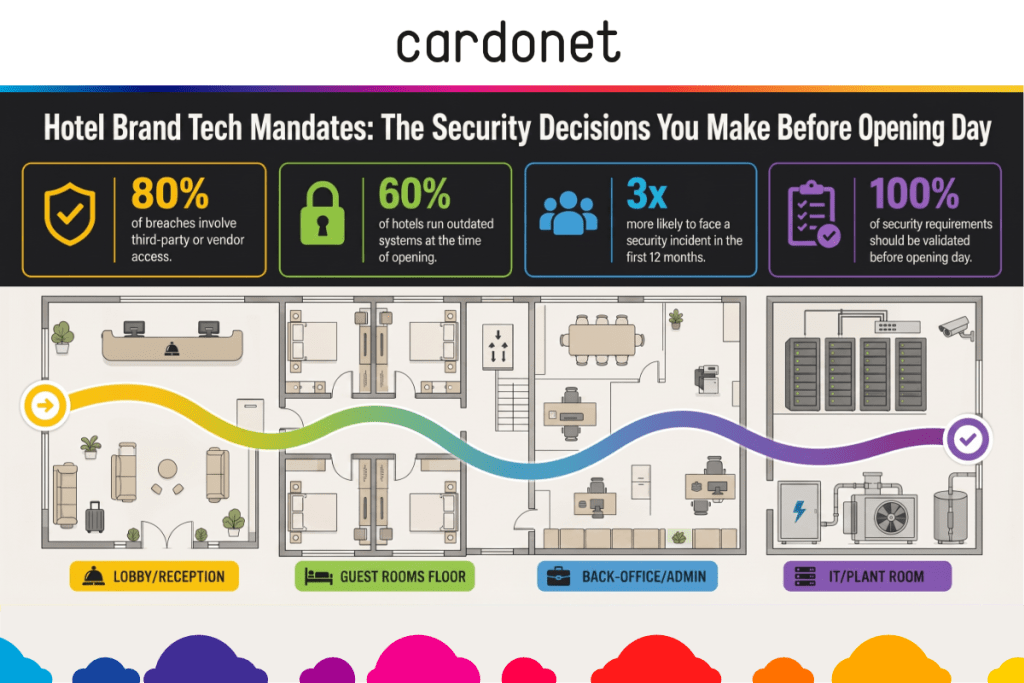
That is why I would bring security design into franchise planning much earlier than most hotel owners do. Not after the PMS decision or once the fit-out is underway but at the same time as core infrastructure, cabling and integration planning.
There is also a business reason to do it early. VikingCloud’s 2025 hospitality report found that 82% of North American hotels were hit with a cyberattack in the previous summer, while 66% of hotel IT and security leaders expected attacks to become more frequent and 50% expected them to become more severe.
Those numbers do not mean every hotel needs to panic. Instead, the industry should stop treating security as a bolt-on after the brand technology stack has already been locked in.
What to negotiate early
Hotel franchise legal terms are often rigid. Technology implementation details and supporting obligations can be less rigid than they first appear, especially before final approvals and procurement are locked.
I would push for clarity in five areas:
- Detailed integration documentation for every required system and data flow.
- A clear responsibility split between the hotel brand, the owner and any third-party vendors.
- Enough implementation time to test connectivity and security controls properly.
- Security and compliance information for mandated platforms and connected services.
- Technical review of the network design before the hotel opens.
This isn’t dramatic but it can improve the quality of decisions made during build and pre-opening.
This is also where experienced sector support matters. Hotels run all day, every day, and the operational cost of muddled ownership across PMS, POS, WiFi, CCTV and back-office systems is high. Cardonet’s hotel support offer is built around that reality, with 24/7/365 coverage and experience across PMS, POS, TMS, guest WiFi and CCTV environments.
The threat picture that hotels ignore
Hospitality remains attractive to attackers because the sector depends on constant availability, processes large volumes of payment data and often runs mixed estates of legacy, cloud and guest-facing technology.
Semperis reported in late 2025 that 52% of surveyed organisations were targeted by ransomware on holidays or weekends, while 78% reduced SOC staffing by 50% or more during those periods. The same study found that 60% of attacks occurred after a major business event such as an IPO, merger, acquisition or layoffs.
Hotels do not need to copy enterprise security programmes in full. They do need to recognise the practical consequence of those trends. If a property is opening, reflagging, changing management structure or rolling out a new mandated stack, distraction goes up at the same moment risk does.
That is another reason I keep coming back to architecture. If the environment is segmented sensibly, a single compromised system is less likely to become an operational crisis across the whole property.
What good looks like
A well-planned franchised hotel does not treat brand compliance and security as separate conversations. The two are linked from the start.
- The hotel knows which systems are mandatory and which are owner-controlled.
- It understands where payment data flows.
- It has a clear network design that separates guest, operational and building systems.
- It has documented integrations, defined ownership and a realistic support model for a live hospitality environment.
That is not over-engineering. It is disciplined planning.
If you are reviewing hotel franchise technology requirements, the question is not simply whether the brand stack will work but whether the stack, the network and the support model make sense together. When they line up, compliance is easier, troubleshooting is faster and security becomes far more practical to manage.
Why this matters
Hotel technology failures impact the front desk, payment flows and the guest experience. That is why infrastructure decisions deserve commercial as well as technical attention.
When the network is flat and responsibilities are blurred, the cost is not only cyber risk. It is slower incident response, wider compliance scope, more vendor finger-pointing and more disruption during the moments when occupancy is highest.
The sector data supports that concern. VikingCloud found that payment and POS systems were the top risk area named by hospitality respondents at 72%, followed by guest WiFi at 56% and front desk systems at 34%.
For owners, that means the middle ground between brand mandates and owner preferences is not really about preference at all. It is about control, accountability and whether the hotel opens with an architecture that will still make sense two years later.
Protecting your hotel: next steps
- Ask for a current diagram showing where guest, operational and building systems sit and how they are separated.
- Request a responsibility matrix for each mandated platform, including support, security and compliance ownership.
- Review the network design before opening day, not after the first audit or first incident.
For your own infrastructure review, Cardonet can assess whether your hotel’s mandated systems, network design and support model line up before they become an operational problem.
FAQs: hotel franchise technology requirements
Can I keep my existing PMS under a franchise agreement?
Usually not. Most franchise structures require approved platforms or approved options, which means the choice is often narrower than owners expect. The more useful question is how the approved platform affects integrations, support responsibilities and security boundaries once it is live.
Do brand WiFi standards cover security as well as speed?
Not necessarily. Brand standards often focus on the guest experience, availability and performance. That is different from deciding how guest traffic is separated from payment systems and operational devices.
Why does network segmentation matter so much for hotels?
Because it reduces unnecessary exposure. PCI guidance makes clear that segmentation can reduce the systems in scope for PCI-DSS and limit the spread of an incident if one part of the environment is compromised.
When should security architecture be reviewed in a hotel project?
Before procurement and build decisions become fixed. Once the fit-out, cabling and system dependencies are already in place, improving segmentation and control usually becomes slower, more disruptive and more expensive.
What sort of IT support model suits a franchised hotel?
One that understands the whole operating environment, not just isolated systems. Hotels need support that can work across PMS, POS, guest WiFi, building systems and always-on operations without losing sight of security or guest impact.
Contact us
Let us help you review how your franchise technology requirements, network design and support model align before they become operational constraints.
You must be logged in to post a comment.