
Most hotel and restaurant groups I talk to are now thinking seriously about how to roll AI out into their businesses, hoping to reap the immense benefits that it promises. Some have already started the process. However, very few have checked whether their current data architecture can actually support their ambitions, and that gap is where the real cost of this technology can sit.
The reason AI is seen as so important is that it – in theory – is an absolute no brainer when it comes to improving forecasting, pricing, customer service, complaint tracking, and staff scheduling. Clients have normally done a bit of research and already have a vendor or large language model (LLM) in mind. What they often haven’t done is make sure that their data is clean, and without clean data AI can cause more problems than it solves.
When I was starting out we used to say “garbage in, garbage out”. That was true then and, because LLMs handle so much more information than we worked with back in the day, if the data is garbage, the outcome can be an absolute, unmitigated disaster. That’s the part of this that worries me.
Why Hotels and Restaurants Want AI
BCG and NYU’s research on AI-first hotels found that hospitality’s AI investment is concentrated in three places: demand forecasting, real-time dynamic pricing, and guest-facing chatbots. That tracks with what we’re seeing. A hotel with two hundred rooms makes thousands of pricing and staffing decisions a week. A restaurant group is doing the same with covers, prep quantities and rotas. An empty room tonight or an empty table at 8pm is an opportunity that’s gone for good, and AI can potentially help close that gap.
The research is credible, but it only tells you where AI spending goes once a business has already adopted the technology. The National Restaurant Association’s 2026 State of the Restaurant Industry report found that only 26% of US restaurant operators were using AI-related tools at all, and just 6% for customer orders. That’s US data, but we can use it as a basis for our UK assumptions. Most operators haven’t started yet, which puts them in the good position of having time to get the groundwork right before they lock in a vendor or an LLM.
Why Your Systems Don’t Agree
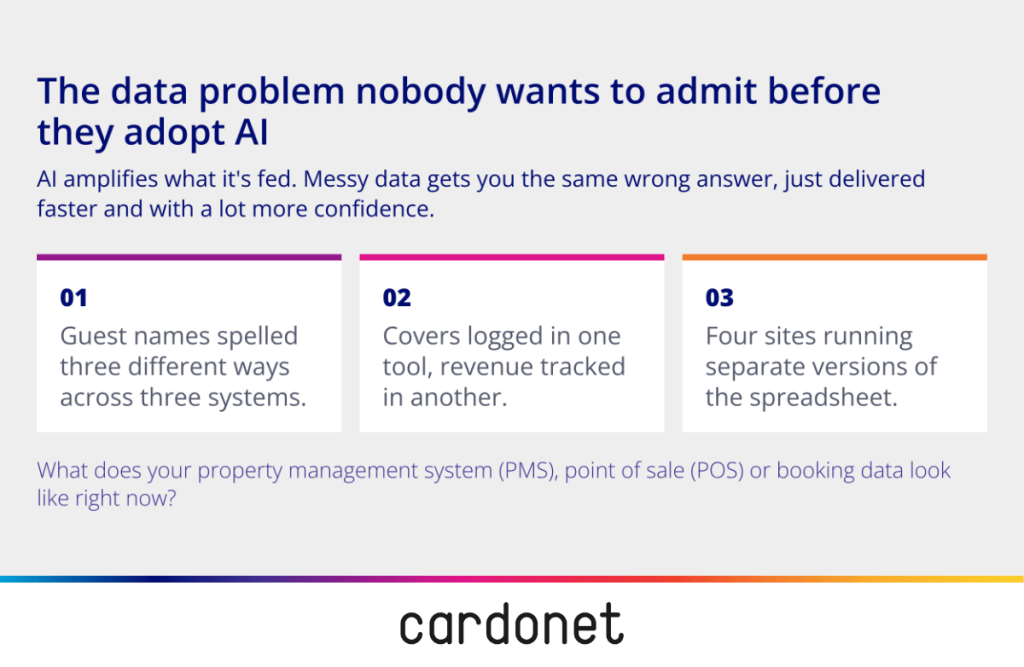
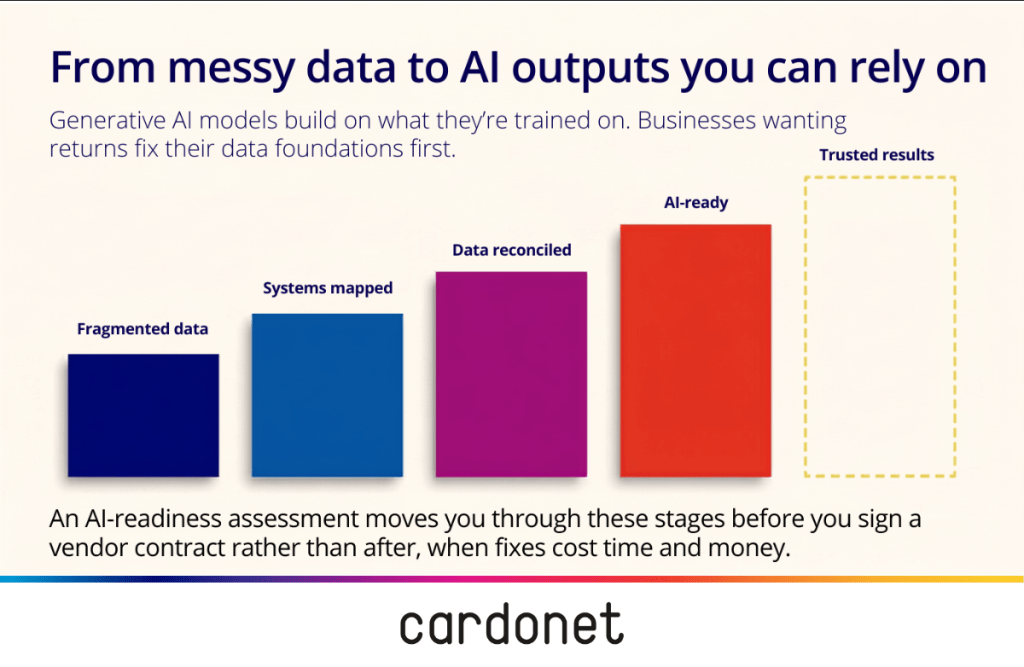
Getting it right starts with knowing what’s actually underneath the systems you already have. In most hotels, the property management system (PMS) interfaces with most of what surrounds it: the point of sale (POS), the booking engine, the channel manager. That integration is standard now, built into most vendor packages from day one. Integration doesn’t automatically deliver consistency, though. A guest’s name can be spelled three different ways depending which system logged it first, and a cover taken on the POS at 8pm can still show up against a different revenue figure in the booking engine if the sync runs on a delay or someone’s corrected one side manually while the other side goes untouched.
This isn’t unusual, and it’s rarely anyone’s fault. Integrations get added one at a time as the business grows, each one solving a specific problem: a channel manager to stop overbookings, a POS upgrade because the old one couldn’t handle a second site, a loyalty system bolted on for repeat guests. Each connection works to its own schedule, and it’s seldom anybody’s job to check that the numbers landing in every system actually match once they’re all connected. The mismatch goes unnoticed until something needs all of it to tally; an AI project is exactly that kind of thing.
AI amplifies whatever’s underneath it, mismatch included. If you feed a forecasting model three different versions of the same guest, it will either see these as three different guests or will build an unjustifiably confident answer from whichever version is taken as true. The output will look exactly as it would were the data clean and that is what makes it so dangerous.
Four Checks Before You Sign
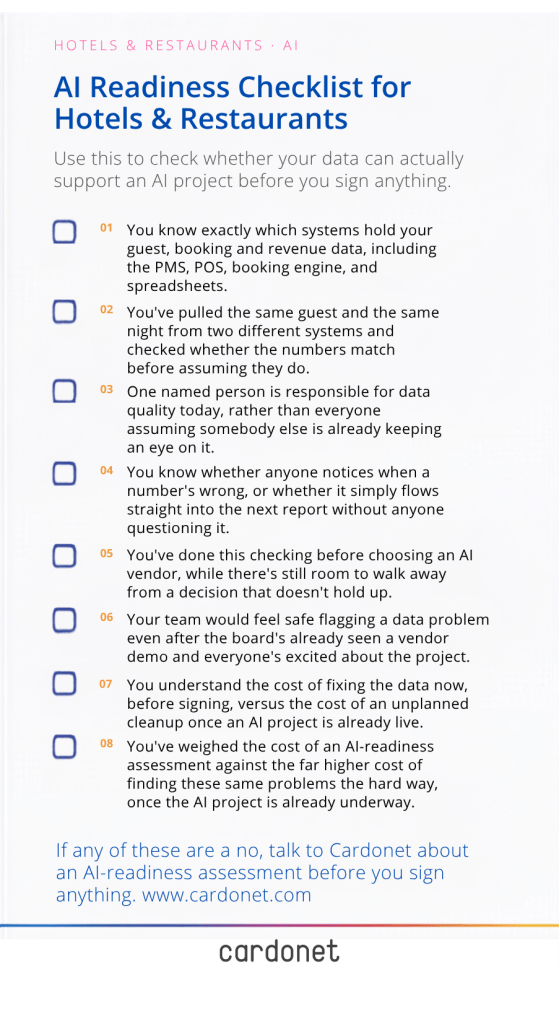
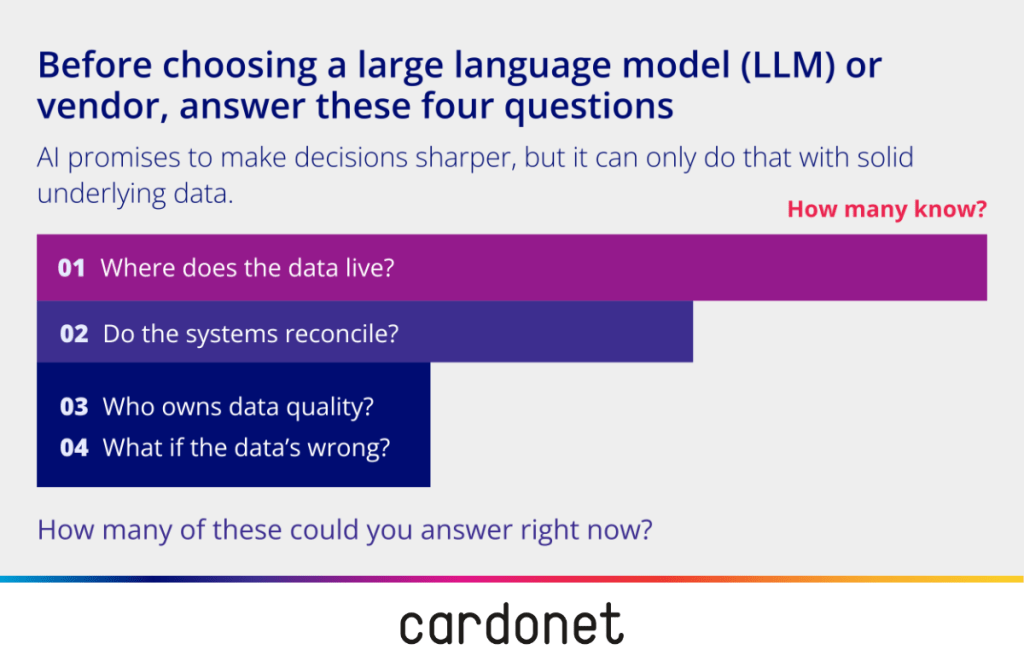
Before I’d recommend any AI tool to a hotel or restaurant client, I’d want four things checked first, and none of them take long:
- Where does the data actually live? Every system needs mapping: the PMS, the POS, the booking engine, and the spreadsheets nobody at head office knows exist. There are usually more of these than anyone expects.
- Do the systems agree with each other? Pull the same guest and the same night from two different systems and compare them. If the numbers don’t match, that’s the finding, and it needs fixing before it needs automating.
- Who owns data quality today? Name one person. In most businesses I’ve worked with, the honest answer is nobody, and that absence of ownership is usually the root cause of everything else on this list.
- What happens when the data’s wrong? Find out whether anyone notices when a number’s off, or whether it just flows into the next report unchallenged. If nobody’s checking, an AI tool won’t start checking either.
These four checks aren’t complicated, and they don’t need to wait for a formal project. Answer them honestly and you know exactly what you’re bringing into an AI project. Skip them and you’ll find out anyway, just later and at a much higher price. It’s the groundwork any decent IT strategy engagement would start with, just narrowly scoped to the systems an AI tool is about to inherit.
Why Nobody Flags the Problem
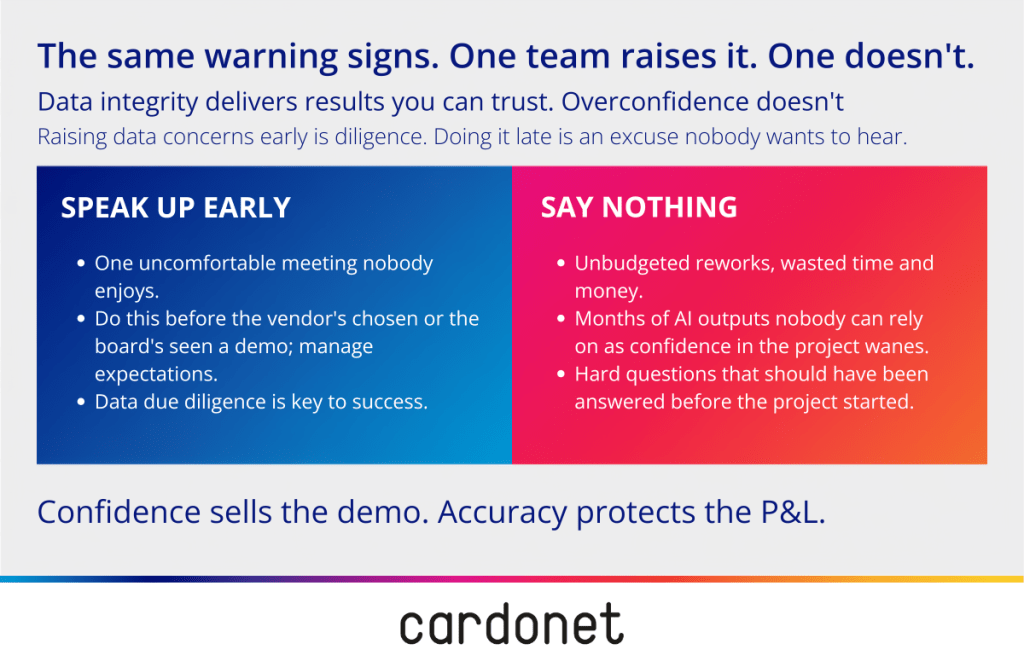
The reason nobody flags this isn’t technical. By the time a vendor’s been chosen and the board’s seen the demo, raising a concern about the data can read as resistance. Fixing it before anyone’s committed reads as diligence.
Two different things are usually going on. One is sunk cost: procurement’s already signed off, the board’s already seen the demo, and admitting the data isn’t ready feels like undoing months of work that somebody else is proud of. The other is a subtler worry, of raising a serious-sounding flag that turns out, on inspection, to be nothing much. Speaking up early costs one uncomfortable meeting, win or lose. Staying silent can cost months of bad forecasts, a vendor asking why the numbers don’t add up, and a rebuild nobody budgeted for.
A confident forecast and an accurate one are not the same thing, and the businesses that do well with AI are usually the ones that check for the second before they trust the first.
What the Numbers Actually Say
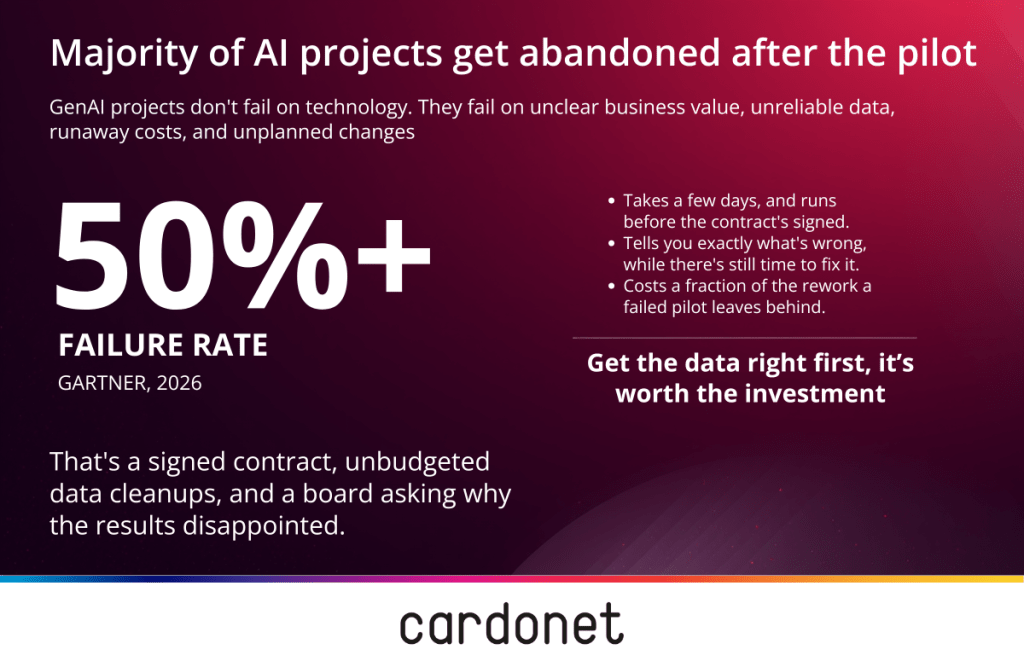
Gartner tracked hundreds of generative AI implementations and found that at least half were abandoned after the pilot stage, with poor data quality among the most common reasons. That’s a global figure spanning every industry Gartner tracked, with no hospitality-specific breakdown given. The mechanism it points to is exactly what I’ve described here: the data breaks the project long before the AI model gets any of the blame.
For a hotel or restaurant group, that abandonment shows up as a signed contract, a data cleanup nobody budgeted for, and a board asking why the forecasted gains are still on a spreadsheet and not in the bottom line.
An AI-readiness assessment, done properly, costs a few days and mitigates the risk. It tells you exactly where the gaps are while there’s still time to fix them, for a fraction of the price of finding out the hard way. That’s still a real cost for a smaller independent operator already stretched thin, and I won’t pretend it isn’t. But it’s a cost you choose to spend, on your own timeline, before you’ve committed to anything else. The alternative costs more. It just arrives later, and takes the choice of timing away from you.
What No AI Vendor Tells You
None of this is an argument against AI in hospitality. The technology genuinely suits an industry built on thousands of small decisions made every week. The point is simpler: check what you’re feeding the model before you sign for it. The data work is the least glamorous part of an AI project but it’s the part that decides whether everything else in the pitch turns out to be true. Once the data’s sound, the ongoing managed IT work of keeping it that way is a far smaller job than the cleanup would have been.
If your business is about to sign an AI contract, or even just weighing one up, get someone to look at what your systems actually contain first. We can run that assessment for hotels and restaurants, because this is where these projects usually go wrong. Book a meeting and we’ll go through your data with you before you go anywhere near a vendor.
Frequently Asked Questions
If an assessment finds problems, are you obligated to use the same provider to fix them?
No. A proper AI-readiness assessment should tell you what’s wrong and where, and what you do with that finding is your decision. Some businesses fix it in-house, some bring in whoever already manages their systems, and some go back to whoever ran the assessment. What matters is that you go into the AI contract already knowing what you’re working with.
Does an assessment like this need access to live systems, or can it work from exports?
Exports are usually enough for an initial check: pull recent data from the PMS, POS and booking engine and compare them for mismatches. If something needs a closer look, a good provider will say so before asking for anything more. Broad access shouldn’t be the starting point.
We’ve already chosen an AI vendor. Is it too late to do this?
Catching this after a vendor’s already been chosen still helps, though the earlier you catch a data problem, the cheaper it stays. Running the four checks first means you go into the contract knowing exactly what you’re handing over. Skip them and you’ll still find out later, when the forecasts come back wrong.
Does this only matter for larger multi-site groups, or does a single independent restaurant or hotel need it too?
This matters at any size, though the maths looks different for a smaller independent operator already stretched thin. The cost of the assessment is real, but it’s a cost you choose to spend on your own timeline. A rebuild later costs more, and you don’t get to pick when it happens.
Will this replace or get in the way of our AI vendor’s own onboarding process?
Ideally, the assessment runs before your vendor’s onboarding begins. It only checks your own systems, so the two processes can run one after another in sequence.
You must be logged in to post a comment.