
When a new hotel is close to sign-off, most of the attention goes to what guests will see. The rooms, the public areas, the finishes and the brand standards get picked apart in detail, while the network that will carry your guest Wi‑Fi, payments, front desk systems, room tech and building controls is too often treated like a secondary package.
That is where a lot of expensive problems begin. The most cost-effective way to get reliable hotel connectivity is to design it properly at blueprint stage, and to treat cabling, Wi‑Fi coverage and room for future systems as part of the building itself – not as late additions that can be squeezed in later.
Once walls are closed and rooms are handed over, every bad assumption becomes harder to fix. What looked like a small compromise on a drawing turns into disruption, rework and avoidable cost in a live hotel.
What needs planning
You do not need to become technical to ask the right questions. But you do need to know what a sensible hotel network infrastructure plan should cover before you approve it.
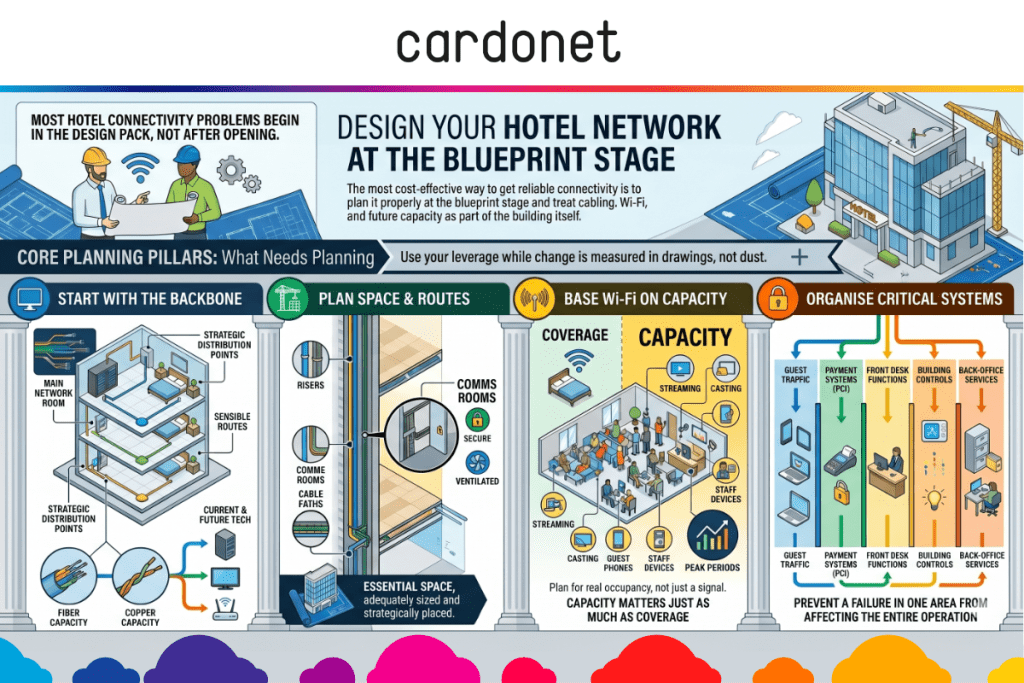
Start with the backbone. A hotel needs a clear physical network structure through the building, with a main network room, smaller distribution points in the right places, sensible routes between them, and enough fibre and copper capacity to support both current operations and the next layer of technology the operator will add later.
Then look at space and routes. Risers, comms rooms and cable paths are not background details. They shape how practical the building will be to run, expand and troubleshoot. If these areas are too small, badly placed or treated as leftover space, the problem does not stay hidden for long.
Wi‑Fi planning also needs to be based on real occupancy and behavior, not just whether a signal reaches the bedroom. Hotels are supporting work calls, streaming, casting, staff devices and peak periods where demand rises all at once. Coverage matters, but capacity matters just as much.
Finally, critical systems should be organized sensibly from the start. Guest traffic, payment systems, front desk functions, building controls and back-office services should not all sit in one muddled environment. If one part fails, you do not want the whole operation feeling it.
Where owners get caught out
The trap is rarely one spectacular mistake. It is usually a cluster of ordinary decisions that seemed harmless at the time and were signed off before the eventual users and supporters of the system had had a chance to make real a real input.
That is how owners end up with buildings that look finished but don’t behave like it, with customer complaints mounting up and staff figuring out work arounds and any proper fixes requiring opening ceilings, pulling more cable, or revisiting spaces that should have been planned better in the first place.
In our experience, this is where the conversation often goes wrong. The issue gets branded an IT failure when in fact support teams are dealing with the consequences of poor infrastructure decisions they did not make.
The expensive shortcuts
Some of the most important decisions in a hotel build are also the least glamorous. No guest praises a sensible fibre route in a review, but poor decisions in these areas are exactly the ones that keep resurfacing over the life of the property.
Cabling is the obvious example. You can replace switches and access points later, but if the physical layer was compromised at build stage, every future upgrade becomes harder than it needed to be. The same goes for equipment space. If telecoms rooms are insecure, badly ventilated, hard to access or simply too tight, the building becomes awkward to support before it has even settled into operation.
Documentation is another area that gets underestimated. Hotels that open with clear records of what was installed, where it runs and what depends on what are much easier to operate. Hotels that do not get this right often spend the next few years paying people to rediscover their own infrastructure piece by piece.
This is also why it makes sense to think about support before opening day, not after it. A hospitality partner with practical hotel IT support experience and strong hotel WiFi solutions insight can challenge assumptions while the drawing set is still flexible, rather than trying to work around them later.
Build for change
The network you install at opening will inevitably end up carrying more than guest phones and laptops. Over time it will support room controls, locks, screens, cameras, sensors and whatever else the hotel adds as guest expectations and operating models evolve.
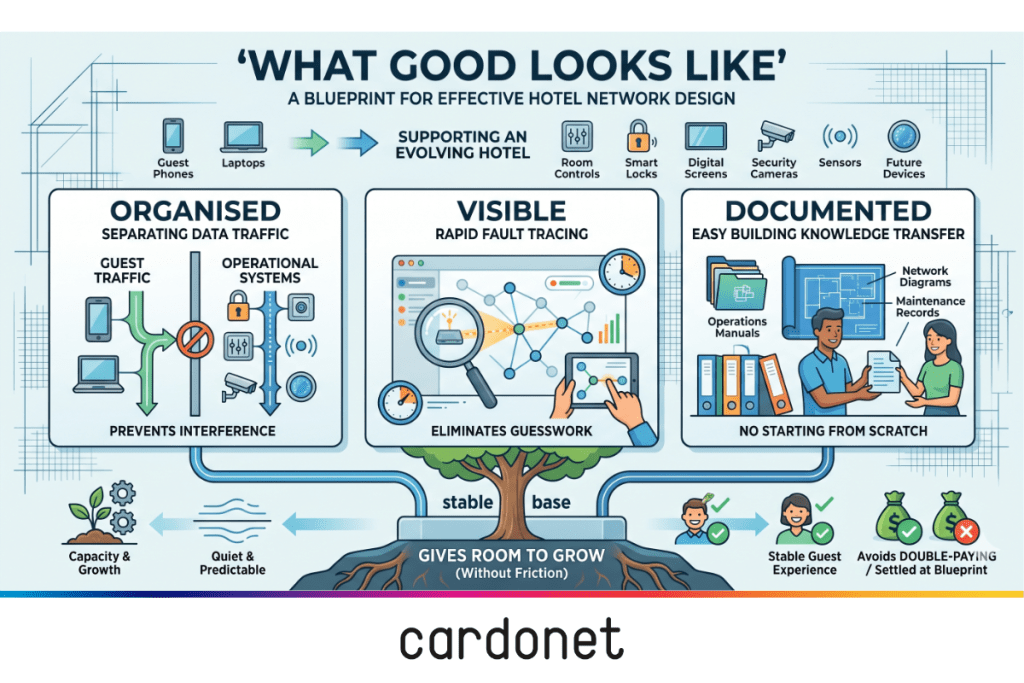
That does not mean trying to predict every future device. It means leaving enough headroom, space and structure that normal change does not turn into another building project. In practice, the strongest designs have three things in common:
- They are organized, so operational systems and guest traffic do not constantly interfere with each other.
- They are visible, so faults can be traced quickly without guesswork.
- They are documented, so the next operator or support team can understand the building without starting from scratch.
This will give the building room to grow without creating fresh friction every time something changes.
Good hotel network infrastructure is not flashy. It is quiet, predictable and easy to live with. It gives operators a stable base for the guest experience, and it stops owners paying twice for decisions that should have been settled properly at blueprint stage.
Why this matters: the 5 Rs
For owners, this is not just an IT topic. Buildings that cannot support dependable connectivity are harder to run, harder to adapt and more likely to ruin the guest experience.
That shows up in familiar ways:
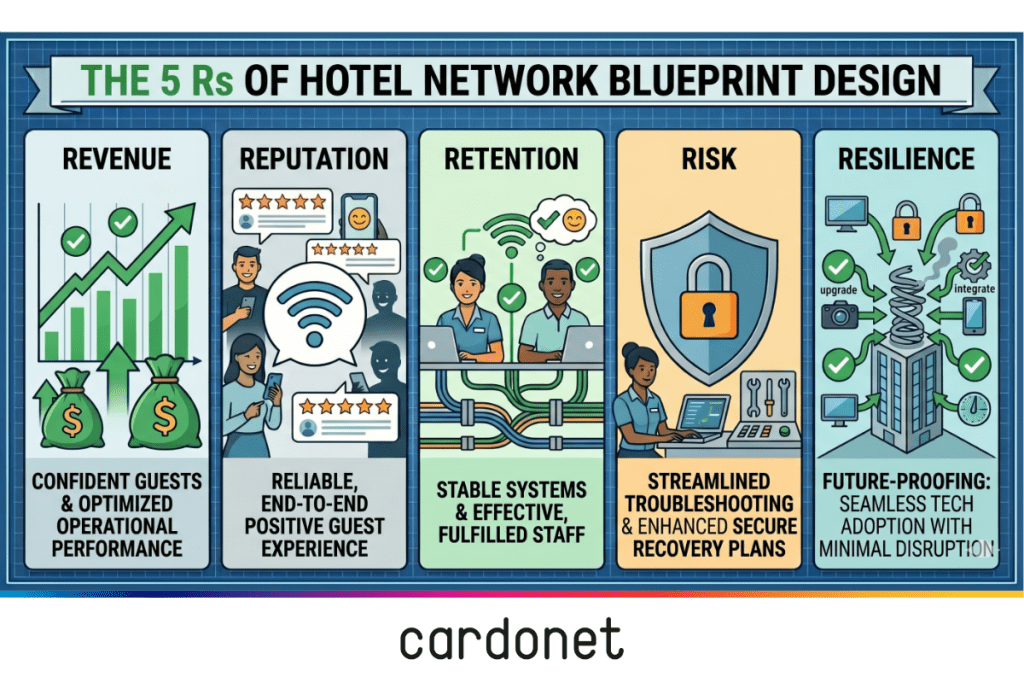
- Revenue – because poor connectivity affects guest confidence, event performance and the smooth running of the operation.
- Reputation – because guests judge the hotel by whether the experience works, not by where the fault started.
- Retention – because staff are more effective when the systems around them are stable and predictable.
- Risk – because badly planned infrastructure is harder to troubleshoot, secure and recover.
- Resilience – because hotels with better foundations can adopt new systems with less disruption and less wasted spend.
Protecting your hotel
Before you approve the next design pack, do three things.
- Ask for a proper review of the network plan, not a vague low-voltage allowance sitting in the wider services package.
- Make the team show you the network rooms, cable routes, capacity assumptions and recovery thinking in plain English.
- Bring in the people who will eventually run the hotel’s systems before those decisions are locked in, whether that is the operator, the brand technology team or a hospitality IT partner.
That is where owners still have leverage. Use it while change is still measured in drawings and meetings rather than dust, delays and variation orders.
FAQs
When should hotel owners lock in network decisions?
Earlier than most do. By the time drawings are approaching sign-off, the backbone, routes, equipment spaces and Wi‑Fi assumptions should already be clear enough that the discussion is about refinement, not invention.
Do guests really notice bad network design, or just bad Wi‑Fi?
Guests usually see the symptom rather than the cause. They notice dropped calls, buffering, poor casting or awkward payment issues, but those symptoms often trace back to physical design decisions made long before opening day.
What is the most common design-stage mistake?
Leaving the network too far down the list until the visible parts of the scheme are already settled. Once that happens, the technology conversation becomes about fitting into leftover space instead of asking what the building actually needs.
What does “future-proof” mean in practice?
Usually it means leaving enough structure and spare capacity that the hotel can add or change systems without reopening finished areas. Better routes, better equipment locations and proper documentation matter more than trying to predict every future device trend.
Who should review the network plan before sign-off?
At minimum, the design team, the owner’s representative, the future operator if known, and someone with real hospitality IT experience. If the operator is not yet appointed, that is even more reason to pressure-test the design against likely operating reality.


You must be logged in to post a comment.