
If you walk into modern hotels in major global cities you can already see where authentication is going. Staff move between shared workstations, tablets and back-office systems using physical tokens or their phones, not passwords, and the result is a faster, cleaner and more defensible operation.
We recently worked with a newly-opened 216-room extended-stay property in a busy downtown location in a large US city. This had been built for longer stays and designed around modern guest expectations. It was launched with a passwordless staff model that replaced traditional passwords with token-based access, backed up by mobile authentication, so the team could work securely on any device without carrying around a set of shared logins.
That is not interesting because it sounds “modern”. It is exciting because it solves a problem hotels have tolerated for too long – shared passwords at the desk, reused credentials across different systems and login details written down because the team is too stretched to do things the right way. It is important because it follows best practice given the massive cybersecurity threats faced by organizations. The UK’s National Cyber Security Centre has now said clearly that passkeys should be the default login option where available, because passwords are no longer resilient enough for current threats.
For me, that is the real story. Global best practice is already live in real hotels. So the question for hotel leaders is no longer whether passwordless is worth the investment; it is whether they want to move on their own terms, or wait until a breach, an audit or a brand requirement forces the issue.
Why hotels are being told to move on
The NCSC has changed its public position in a meaningful way. It now says passkeys should be consumers’ first choice of login across digital services, and it no longer recommends passwords where passkeys are available. It also says passkeys are at least as secure as, and generally more secure than, strong passwords paired with two-step verification.
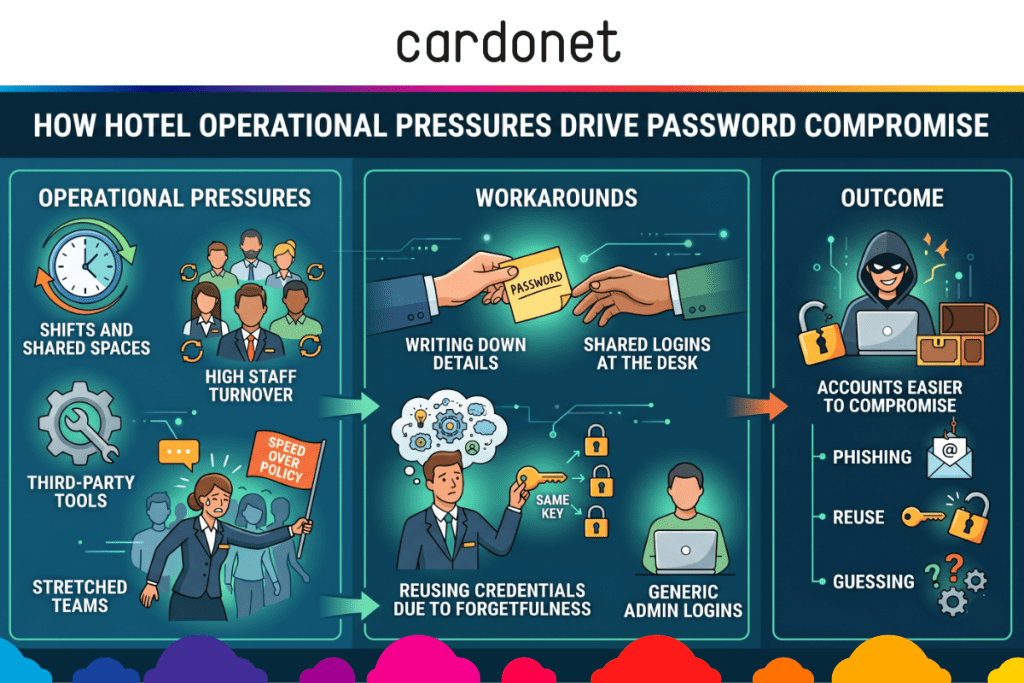
That matters for hotels because the old password model was always a poor fit for hospitality operations. Hotels run on shifts, shared spaces, high staff turnover, third-party tools and moments of pressure where speed matters more than policy. In that environment, shared or recycled passwords are not an exception. They are what happens when the technology design does not reflect the reality of the operation.
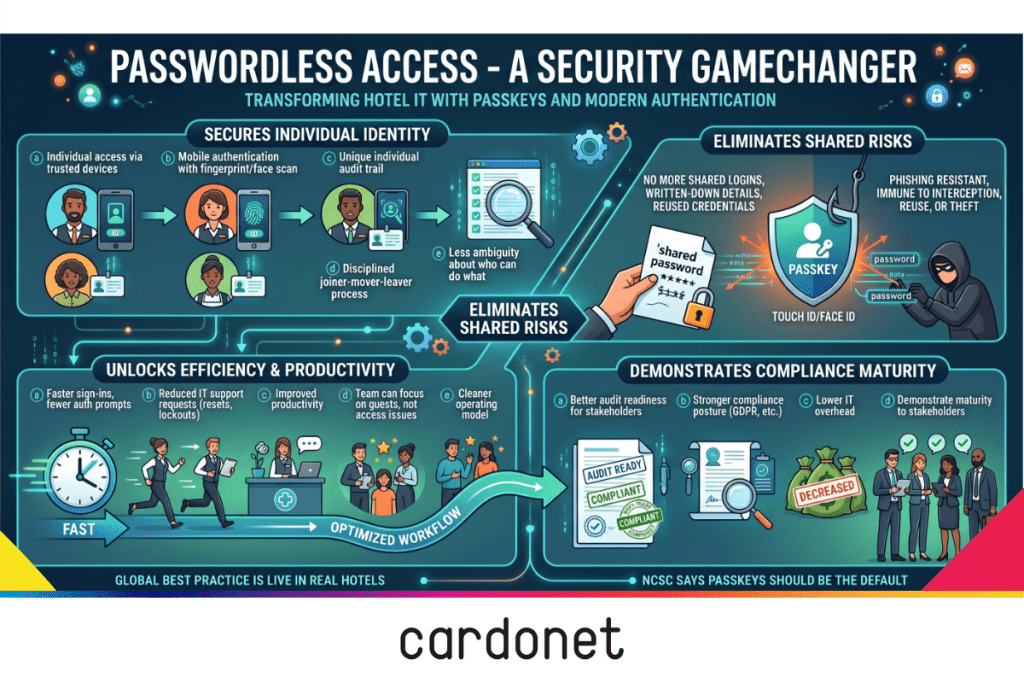
The NCSC also makes the user point clearly in its guide to what passkeys are and how they work. Passkeys are designed to be easier to use because the credential is created and stored safely on a trusted device and unlocked by the same method someone already uses on that device, such as a fingerprint, face scan or PIN. In plain English, that means a better security model and less friction at the same time, which is exactly why this is now becoming a practical hotel operations issue, not just a cyber one.
The real problem passwords created
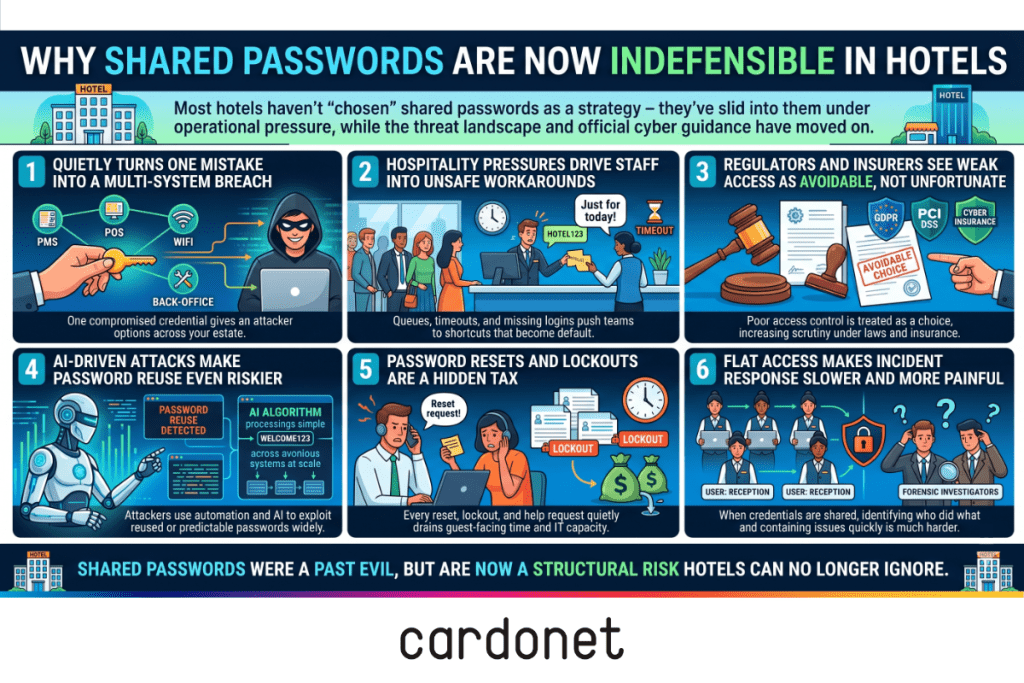
If you want to understand why this matters, look at how most hotels still work. A front-desk password gets passed across shifts. A manager reuses a familiar pattern on multiple systems because they cannot remember five different credentials. A supplier still expects a generic admin login to support a back-office tool. None of that is unusual. It is how weak access habits become embedded in a live operation.
That creates two problems at once. The first is obvious – it is easier for attackers to compromise accounts through phishing, reuse or guessing. The NCSC says passkeys are resistant to phishing and cannot be intercepted, reused or stolen like passwords can. The second problem is operational. Password resets, lockouts and account confusion quietly eat time every week, both for hotel teams and for whoever supports the estate.
This is why I do not see passwordless as a narrow cyber upgrade. It is a cleaner operating model. Once you move away from shared credentials and start tying access to individual people and trusted devices, you get a better audit trail, a more disciplined joiner-mover-leaver process and less ambiguity about who can do what. In a hotel setting, that reduces both risk and background noise.
What passwordless looks like in practice
The hotel example behind this article is useful because it makes the concept concrete. The hotel team can work on any device as if it were their own, using a physical token with a phone as backup, rather than relying on memorised passwords. The benefits are practical. Faster sign-ins. Fewer authentication prompts. Reduced need to raise IT support requests. Better confidence that the team can stay focused on guests rather than getting stuck on access issues.
There is also a wider leadership benefit. The owners and operators gained a stronger cyber security stance, lower IT overhead and a better compliance posture, with stronger audit readiness for stakeholders. That is the point where passwordless stops being a technical feature and becomes part of the hotel’s overall operating standard.
This is also the broader direction of travel for the industry. The NCSC says the digital industry is moving rapidly towards passwordless authentication and that major platforms already support passkeys. It also says passkey logins can be much faster than signing in with a username, password and two-step verification code. Better security on its own is not always enough to drive adoption. Better security plus better user experience usually is.
Security, compliance and cost
No serious hotel group wants to be having an avoidable discussion with owners, brands or auditors about shared passwords. Passwordless does not solve every access problem overnight, especially where older systems are involved, but it does move the organization towards a stronger baseline. The NCSC is also clear that where passkeys are not available, strong passwords generated by a password manager and protected by two-step verification should remain the fallback.
That is an important point because it keeps the conversation realistic. Not every hotel system will support passkeys today. Some legacy PMS, finance or specialist tools may still need a transitional approach. But that is not an argument for doing nothing. It is an argument for mapping the estate properly and moving the areas that can move now.
The business case is broader than breach prevention. In our practical hotel example here, passwordless access reduced cyber risk, improved team satisfaction, improved productivity and lowered IT overhead. That is why hotel leaders should care. Better access controls can reduce attack surface, but they can also cut support friction and strengthen the hotel’s ability to demonstrate maturity to stakeholders.
For hotels thinking about the wider operating picture, this is where Cardonet’s own work across hotel cyber security, hotel IT compliance and broader hospitality IT solutions becomes relevant. Passwordless only works well when it is tied into the wider architecture, not bolted on as yet another disconnected tool.
How a hotel should start
The wrong approach is to announce a blanket passwordless rollout without understanding what the estate can support. The right approach starts with questions:
- Where are passwords shared today?
- Which systems cause the most login friction?
- Which platforms already support modern authentication?
- Which roles create the highest operational or security risk if access is weak?
From there, the path is usually straightforward.
- Map where staff actually log in today.
- Identify which systems already support passkeys or other modern authentication options.
- Pilot with a defined group before expanding.
- Measure the impact on speed, support demand and access control.
- Build the wider roadmap around operational reality, not slogans.
That is how passwordless becomes part of hotel operations instead of another half-finished IT initiative. A lot of hotel IT decisions get postponed because the current workaround feels tolerable. Passwords fall into that category: teams cope, IT resets accounts, and managers share credentials when they have to.
The problem does not feel urgent until something breaks.
What changes the picture now is that the operational example and the policy guidance are lining up. The practical model exists, the security case is clear, and the user experience improves.
The official advice now points in the same direction. If a hotel wants a straight answer on where passwordless fits into its roadmap, the sensible next step is not to buy a tool. It is to review where passwords are still driving risk, friction and avoidable support overhead across the estate. Only then should they decide what should move first.
FAQs
What does passwordless mean in a hotel setting?
In a hotel setting, passwordless means staff use trusted devices, physical tokens, passkeys or mobile authentication instead of typing shared or memorized passwords. The aim is to make access both more secure and easier to manage in a live operational environment.
Are passkeys now recommended over passwords?
Yes. The UK’s National Cyber Security Centre now recommends passkeys over passwords wherever they are available and says passwords are no longer resilient enough for modern threats.
Can passwordless reduce hotel IT overhead?
Yes. A passwordless model can reduce password reset requests, login confusion and support tickets, while giving teams a faster and more consistent sign-in experience across devices.
Do hotels need to remove every password at once?
No. Most hotels will need a phased approach because some legacy systems may still rely on passwords. Where passkeys are not available, strong passwords and two-step verification remain the sensible fallback.
Why should hotel leaders care about this now?
Hotel leaders should care because passwordless access strengthens cyber security, improves team experience, reduces avoidable IT friction and supports a stronger compliance and audit posture.
You must be logged in to post a comment.