

The Invisible Balance Sheet
Every startup begins with a loan. I don’t mean the venture capital in the bank or the credit line from the bank. I mean the loan you take out against your own code.
In the early days, speed is the only currency that matters. You need to ship the MVP. You need to close the Series A. So, you make compromises. You hard-code a credential here; you skip a unit test there. You build a monolithic architecture because microservices take too long to configure. You tell yourself the most dangerous lie in software engineering: “We’ll fix it later.”
But “later” is a deceptive horizon. In my experience auditing technical infrastructures for growing companies, “later” rarely arrives. Instead, what arrives is the bill.
Technical debt is not an abstract engineering concept; it is a financial instrument. It functions exactly like high-interest consumer debt. You borrow time today to ship a feature, but you must pay interest on that time every single day thereafter. The interest is paid in slower development cycles, higher bug rates, and frustrated engineers.
Eventually, if you don’t pay down the principal, the interest payments consume 100% of your available capacity. You enter technical bankruptcy: the state where you can no longer ship new features because you are spending every working hour just keeping the lights on.
The Financial Stakes: A 40% Tax on Innovation
If you walked into a board meeting and proposed a 40% tax on all future innovation, you would be fired. Yet, this is exactly what technical debt is doing to IT budgets across the UK.
According to data from the Consortium for Information & Software Quality, technical debt costs companies trillions annually in lost productivity. More specifically, recent McKinsey analysis reveals that technical debt now consumes up to 40% of IT budgets.
Think about the architecture of that cost. This isn’t just an operational expense; it is a liquidity crisis sitting on your balance sheet. For every £1 you spend on engineering salaries, 40p isn’t buying you innovation. It isn’t buying you speed. It isn’t buying you market share. It is simply servicing the interest on shortcuts you took three years ago.
For a startup with a limited runway, this is fatal. Scale-ups burn through Series B capital by frantically rewriting a platform that was never designed to handle customers rather than by acquiring them. The “burn rate” becomes a “churn rate”—burning cash to fix old code rather than build new value.
The Technical Reality: Operational Paralysis
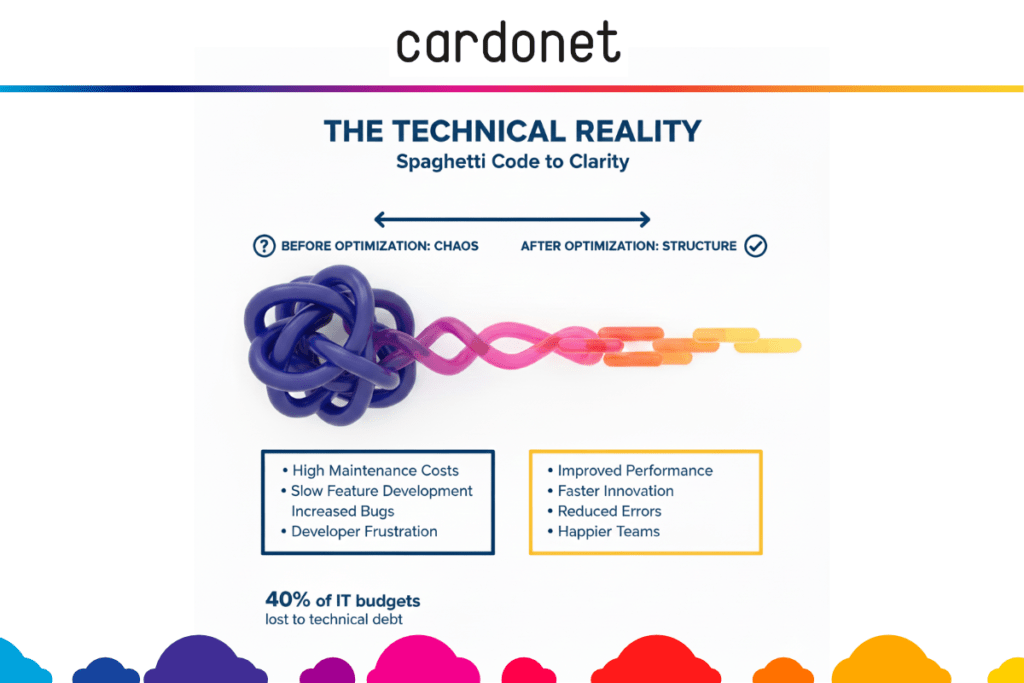
What does this debt look like on the ground? It rarely looks like a dramatic explosion. It looks like sludge.
It’s the “spaghetti code” in the back-end that scares new hires into silence during code reviews. It’s the legacy server that no one wants to patch because “last time we touched it, the checkout page went down for six hours.” It’s the temporary API workaround from 2023 that is now a load-bearing column holding up your entire enterprise architecture.
When we work with CTOs, we look for the signs of Operational Paralysis.
Research indicates that 84% of UK businesses report being held back by legacy systems and technical debt. In practical terms, this means development teams can spend up to 64 hours per sprint just fixing regressions and bugs caused by fragile code.
But the paralysis often runs deeper than code. In many startups, your high-value engineers aren’t just fighting code debt; they are fighting infrastructure fires. They are rebooting servers, managing user access, and troubleshooting VPNs.
When a team spends the majority of their time on maintenance—both code and infrastructure—velocity drops to near zero. You might thinkyou are moving fast because the engineering team is working late nights and the Jira board is active. But you are running on a treadmill—high effort, zero distance.
The Human Cost: The Capability Trap
We often measure technical debt in server costs or refactoring hours. But the real cost—and the one that usually kills the company—is human.
Your best developers aren’t leaving for more money. They are leaving because they are tired of being firefighters.
There is a system dynamics concept called the Capability Trap that explains why high-performing engineering teams collapse under debt:
- The team is under pressure to ship fast.
- They cut corners (take on debt) to meet the deadline.
- The codebase gets messier, so it takes longer to add features next time.
- The pressure increases because velocity has slowed.
- They cut more corners to compensate.
It is a death spiral. It destroys psychological safety. When developers are forced to ship code they know is fragile, they feel a loss of professional pride. They know they are building a house of cards, and the anxiety of waiting for it to collapse—usually at 3am on a Saturday—is the primary driver of burnout.
It is no surprise that 91% of CTOs now rate technical debt as a bigger challenge than cyber threats. They are more worried about their own code imploding than they are about external hackers.
The Solution: Liberate Capacity to Pay It Down
You cannot declare bankruptcy on your code (unless you are willing to shut down the company). You must pay it off.
The most effective strategy is the 20% Rule: Every single sprint, 20% of engineering capacity is reserved specifically for technical debt reduction. This is non-negotiable.
But here is the catch: You cannot ring-fence 20% of your capacity if your team is constantly dragged into infrastructure firefighting and user support.
If your Lead Developer is spending their morning troubleshooting office Wi-Fi or provisioning laptops for new hires, you do not have the capacity to pay down debt. You are effectively paying your most expensive resources to do utility work while your strategic asset (your product) rots.
The strategic move is to offload the noise.
Smart scale-ups rely on a third-party partner to manage the “keeping the lights on” work—core infrastructure, user support, and security monitoring. By shifting the operational burden of the IT estate to a specialist, you buy back the engineering bandwidth required to attack your technical debt.
This allows you to implement the 20% Rule with integrity. It signals to your product team: “We are taking the distraction of infrastructure support off your plate so you can focus entirely on building a stable, scalable product.”
Conclusion: Assets vs. Liabilities
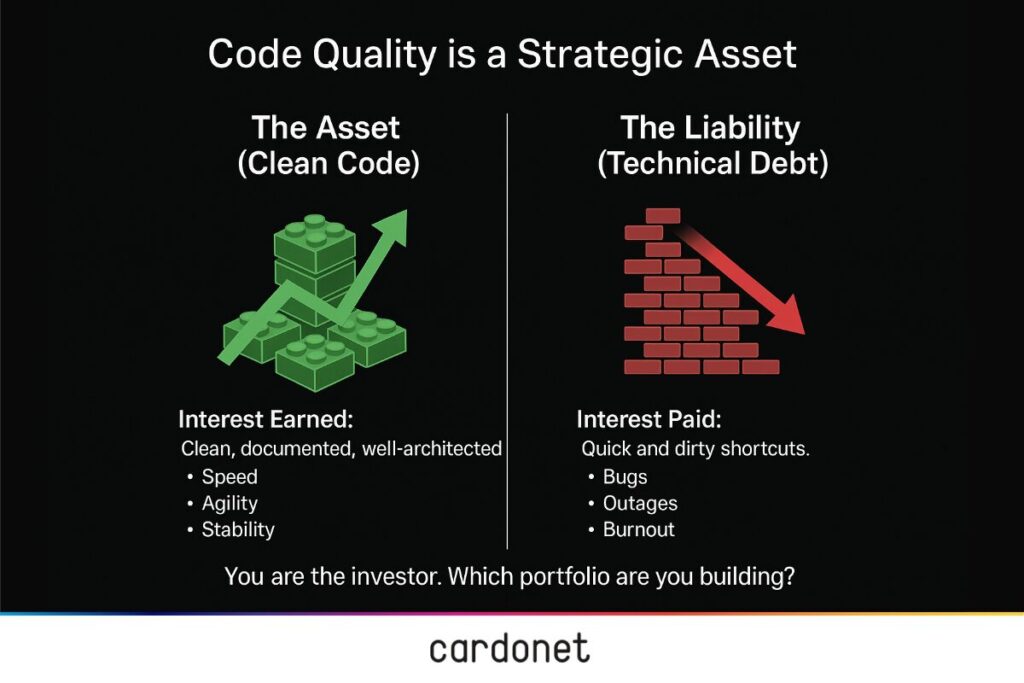
In the end, code quality is not an aesthetic choice for perfectionists. It is a strategic asset.
Clean, documented, well-architected code is an asset that generates interest in the form of speed, agility, and stability. “Quick and dirty” code is a liability.
But you can’t build an asset if you’re drowning in liabilities. Clear the operational decks. Partner on the infrastructure. Free your team to build the future.
You are the investor. Which portfolio are you building?
FAQs
Q: Is all technical debt bad?
A: No. “Good” debt is a deliberate choice to ship faster for a specific strategic reason (like hitting a market window), with a specific plan to pay it back. “Bad” debt is accidental sloppiness or “mess” that happens without a plan. The key is to track it and pay it back, regardless of the type.
Q: How does outsourcing infrastructure help with code debt?
A: It’s a capacity game. If your engineers are spending 10-15% of their week on environment issues, patching, or user support, that is time stolen from refactoring. Outsourcing the infrastructure creates the “time budget” needed to pay down the code debt.
Q: Can we just pause feature development for a month to fix everything?
A: This rarely works. It creates a “stop-start” cycle that frustrates the business and sales teams. It is far better to integrate debt reduction into your continuous workflow (the 20% Rule) so it becomes a habit, not a one-off project.
Q: What is the first area of technical debt we should tackle?
A: Focus on “High Interest” debt—the code that changes frequently and breaks often. Fixing code that is stable and rarely touched offers a low return on investment, even if it is “ugly.”
Q: How do we measure technical debt?
A: You can’t measure it directly like revenue, but you can use proxy metrics: “bugs per sprint,” “code churn,” “cycle time,” and “change failure rate.” If these metrics are trending in the wrong direction, your debt load is increasing.



You must be logged in to post a comment.